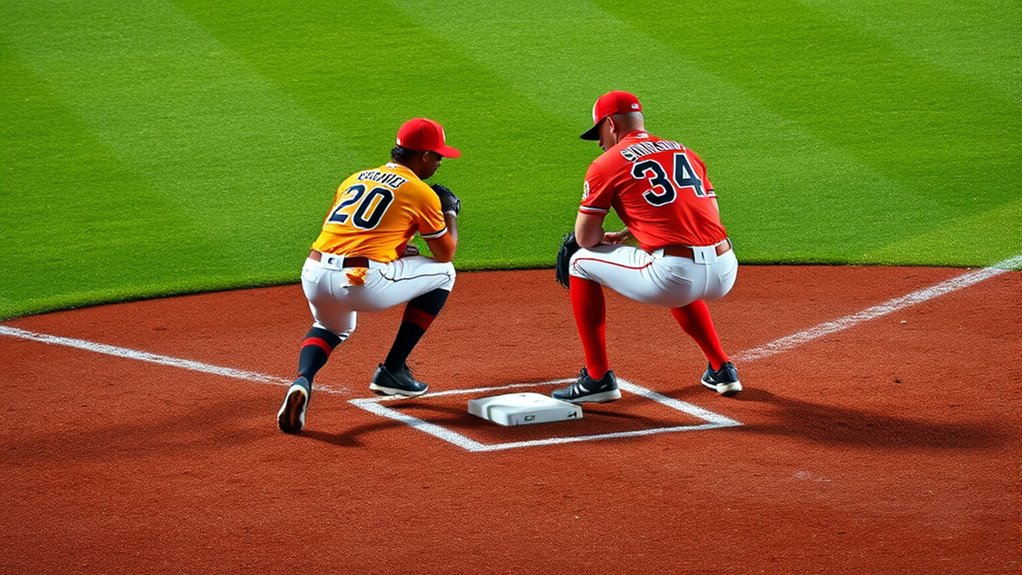

You should move your infielders strategically based on the hitter’s tendencies and game situation. If a batter consistently pulls ground balls, shift infielders toward that side to cut down hits and turn plays into outs. Adjust shifts depending on whether you’re protecting a lead or trying to induce weak contact. Communicate with your pitcher and teammates to make sure everyone’s aligned, and consider factors like count and pitch type. Keep exploring how these shifts can be optimized for better defense.
Key Takeaways
- Move infielders based on hitter’s spray charts to target likely hit directions.
- Adjust shifts according to game situation, such as protecting a lead or facing a power hitter.
- Shift more aggressively against pull-happy batters to prevent extra-base hits.
- Position infielders to support pitcher’s delivery and maximize reaction time.
- Use data and tendencies to execute shifts that turn ground balls into outs and limit scoring.

Infield shifts have become a strategic staple in modern baseball, fundamentally changing how teams defend against hitters. When you consider the effectiveness of these shifts, it’s clear that pitcher mound positioning plays a crucial role in executing successful infield alignment strategies. By adjusting the pitcher’s position on the mound, you can influence the overall defensive setup, making it easier to anticipate where the ball might be hit. For example, a pitcher who frequently faces pull-happy hitters can work in tandem with infielders to favor certain sides of the field. This adjustment not only helps prevent hits but also enables quicker plays, especially against ground balls.
Your infield alignment strategies revolve around analyzing a hitter’s tendencies and adjusting your players’ positions accordingly. When you know a batter pulls the ball to the right side, you might position the first and second basemen closer to the hole, while shifting the third baseman slightly over toward the pull side. Conversely, for power hitters who frequently go the other way, you’d shift the entire infield to the opposite side of the field. The key is understanding the hitter’s spray chart and leveraging that knowledge to position your players effectively. You might also consider the game situation—whether you’re protecting a lead or trying to force a weak contact—when deciding how aggressive or conservative your shift should be.
Adjust your infield positions based on hitter tendencies and game context for optimal defensive alignment.
Your decisions about infield alignment strategies are also influenced by the count, the pitch type, and the batter’s swing pattern. For instance, if you’re ahead in the count and expecting a pitch outside, you might shift slightly to defend against a pull or a bunt attempt. If the pitcher is throwing a lot of breaking balls that induce grounders, adjusting the infield to anticipate a certain direction can cut down on base hits. The pitcher’s mound positioning, including your stance and delivery, can further complement these shifts, making it easier for your infielders to react quickly. Proper coordination between the pitcher and the defense is essential; you want your movements to be synchronized so that, when the ball is hit, everyone knows exactly where to go. Additionally, leveraging data-driven strategies can help refine your infield positioning to maximize effectiveness.
In the end, mastering pitcher mound positioning and infield alignment strategies allows you to take control of the game. It’s about reading the hitter, understanding their tendencies, and executing your shifts with precision. When done correctly, these strategies can turn routine grounders into outs and limit scoring opportunities, giving your team a significant advantage in close games.

Baseball Infield Training Aid Fungo
Infield and Outfield Baseball Training
As an affiliate, we earn on qualifying purchases.
As an affiliate, we earn on qualifying purchases.
Frequently Asked Questions
How Do Pitchers Influence Infield Shift Decisions?
You influence infield shift decisions through pitcher-batter dynamics and pitch selection. By analyzing a batter’s tendencies, you can adjust your pitch types and locations to exploit weaknesses. For example, if a batter struggles with inside pitches, you might shift to pull the ball. Your choice of pitches and how you execute them directly impact the ideal shift, helping you neutralize the hitter’s strengths and increase your chances of success.
What Are the Risks of Overly Shifting Infield Players?
Overly shifting infield players can backfire by creating gaps that batters can exploit. You risk reducing coverage on key areas, making it easier for hits to land safely. Excessive fielder positioning and aggressive infield alignment may lead to missed plays or errors, especially if the shifts are poorly timed or too extreme. Ultimately, balance is key to maintaining solid defense without opening up vulnerabilities for the opposing team.
How Do Batter Tendencies Affect Shift Positioning?
You might think batter tendencies don’t matter, but they do—imagine that! By analyzing hitter spray charts and pull tendencies, you can position your infield more effectively. If a batter favors pulling the ball, shifting that way increases chances of a quick out. Conversely, if they spray hits all over, a more balanced setup keeps you flexible. Ignoring these clues risks giving up big hits; pay attention to the tendencies!
Are Infield Shifts More Common in Specific Leagues or Levels?
Infield shifts are more common in professional leagues like MLB, where advanced analytics drive player positioning strategies. You’ll notice teams at this level often use detailed data to optimize shifts based on batter tendencies and defensive strengths. At lower levels or amateur leagues, shifts are less frequent because teams rely more on traditional positioning and less on sophisticated analytics. So, if you see more shifts, it’s likely due to the emphasis on advanced analytics guiding player positioning.
How Do Infield Shifts Impact Overall Defensive Strategy?
Infield shifts considerably impact your overall defensive strategy by optimizing player positioning based on statistical analysis. By adjusting your infield setup, you can better anticipate where batted balls are likely to go, increasing your chances of making outs. This approach makes your defense more adaptable and efficient, especially against strong hitters. Using data-driven insights, you can fine-tune your positioning to reduce hits and improve your team’s success rate.
baseball spray chart analysis tool
As an affiliate, we earn on qualifying purchases.
As an affiliate, we earn on qualifying purchases.
Conclusion
Knowing when to shift your infield players is like steering a ship through changing tides—you must read the signs and adapt quickly. By understanding the batter’s tendencies and game situation, you can turn the field into your strongest ally. When executed at the right moment, a strategic shift can be the difference between a hit and an out. So, stay alert, stay flexible, and let your infield shifts be the secret weapon in your game plan.

Orignial Youth Baseball & Softball Coaching Guide – 40 Defensive Situations with Player Positioning – Spiral-Bound Playbook, Cutoffs, Relays, Bunt Defense & Baseball IQ Training – Baseball Gifts
40 DEFENSIVE GAME SCENARIOS – Youth baseball/softball coaching playbook covering cutoffs, relays, bunt defense, popup priority & double…
As an affiliate, we earn on qualifying purchases.
As an affiliate, we earn on qualifying purchases.

Hikeen 2 Packs Baseball Training Gloves Infield Train Gloves Pancake Glove Softhands Baseball Fielding Training Flat Glove Two-Hands
BECOME A BETTER FIELDER: Strengthen the use of both hands and quickly improve your baseball defensive skills.
As an affiliate, we earn on qualifying purchases.
As an affiliate, we earn on qualifying purchases.