Softball training aids cover a wide range of gear, and the biggest mistake I see buyers make is treating them all as interchangeable. A swing-path corrector like the SwingRail, a mechanics guide like the Perfect Circle pitching aid, and a solo hitting station like the SKLZ Hurricane solve completely different problems. The main tradeoff in this category comes down to feedback quality versus independence: wearable trainers that correct your mechanics need supervision and patience, while standalone stations let players practice alone but do less to fix the underlying swing. Budget matters too — simple elastic-band trainers cost a fraction of a steel-frame hitting station, and that price gap usually reflects durability and how long the equipment stays useful. Below, I ranked five options by how well each one serves a specific type of player, from a nine-year-old learning proper hand path to an advanced hitter chasing bat speed.

Get sports gear delivered free with Prime
- Fast, free delivery on millions of items
- Prime Video, Amazon Music and more included
- Member-only deals all year
Complete the kit


Key Takeaways
- The SwingRail is the best overall pick for hitters aged 9+ because it corrects swing mechanics directly, but it works best off a tee rather than against live pitching.
- The SKLZ Hurricane is the strongest option for solo practice — no partner, no pitcher, no tee — but its 37-lb steel frame makes it a backyard fixture rather than travel gear.
- The GoSports Pinpoint suits intermediate and advanced hitters only; beginners will find its 3-level feedback system frustrating without a coach to interpret it.
- The Perfect Circle is the lone pitching-specific pick here, supporting six pitch types for windmill mechanics, but its elastic band will wear out with heavy use.
- The adjustable resistance-band hitting trainer is the budget-friendly all-ages entry point, though it ships with no training guide and needs consistent use to pay off.
| SwingRail Baseball/Softball Hitting Trainer |  | Best Overall for Swing Mechanics | Ages: 9 and up | Training Focus: Swing mechanics, bat speed, timing | Feedback Type: Immediate physical feedback on hand path | VIEW LATEST PRICE | See Our Full Breakdown |
| GoSports Pinpoint Baseball & Softball Swing Trainer Batting Aid |  | Best for Intermediate and Advanced Hitters | Target Age: 10 and up | Feedback System: 3-level: Dialed, Close, Off-path | Skill Level: Intermediate to advanced | VIEW LATEST PRICE | See Our Full Breakdown |
| Perfect Circle Softball Pitcher’s Training Aid |  | Best for Pitching Mechanics | Fits: Youth and adult | Pitches Supported: Fastball, change-up, drop ball, screw ball, rise ball, curve ball | Feedback Type: Instant mechanical feedback | VIEW LATEST PRICE | See Our Full Breakdown |
| Baseball Hitting Trainer Swing Practice Softball Batting Training Equipment |  | Best Value Resistance-Band Trainer | Resistance Bands: 4 levels | Height Adjustment: 28″ to 43″ | Durability: Tested for 50,000 hits | VIEW LATEST PRICE | See Our Full Breakdown |
| SKLZ Hurricane Baseball and Softball Swing Trainer | 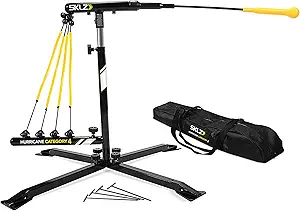 | Best Solo Hitting Station | Height Range: 23 to 38 inches | Weight: 37 lbs | Frame Material: Steel | VIEW LATEST PRICE | See Our Full Breakdown |
| softball training aids equipment | Includes | Skill Level | Training Focus | Feedback Type |
|---|---|---|---|---|
| SwingRail Baseball/Softball Hi | Online instructional videos | Beginner through intermediate | Swing mechanics, bat speed, timing | Immediate physical feedback on hand path |
| GoSports Pinpoint Baseball & S | Universal bat attachment, adjustable armband, instructional video | Intermediate to advanced | Contact, power, bat speed | — |
| Perfect Circle Softball Pitche | User instruction | Beginner through advanced | Windmill pitching arm path | Instant mechanical feedback |
| Baseball Hitting Trainer Swing | Trainer unit only; no training guide | All skill levels | — | Real-time visual and physical |
| SKLZ Hurricane Baseball and So | Carry bag, metal stakes | Youth through advanced | — | — |
More Details on Our Top Picks
SwingRail Baseball/Softball Hitting Trainer
The SwingRail earns the top spot because it attacks the root cause of most hitting problems rather than the symptoms. Instead of measuring bat speed or counting reps, it physically guides the hands through the correct swing path and gives immediate feedback the moment a player casts, drops the barrel, or loops. For a hitter aged nine and up who keeps making the same mechanical mistake, this is the fastest correction tool in the lineup — no other product here changes swing mechanics this directly.
The tradeoff is that the SwingRail is a teaching tool, not a practice station. It works best during tee work and controlled front toss, where the player can slow down and feel the corrected path. Against live pitching, its value drops sharply, because a hitter mid-at-bat can’t process mechanical cues. Compared with the GoSports Pinpoint, which reads out swing quality in three levels for advanced players, the SwingRail is more physical and less analytical — better for a 10-year-old building habits, less useful for a varsity hitter diagnosing contact issues. And unlike the SKLZ Hurricane, it requires the player to already have a bat, a tee, and ideally a tosser.
Parents should also know that younger or less experienced players can struggle with it. The device only works if the player understands what the feedback means, which is why the included online instructional videos matter — watch them together before the first session, or the aid becomes a frustrating wrist restraint rather than a trainer.
Pros:- Directly corrects swing mechanics rather than just measuring them
- Immediate feedback on every swing builds muscle memory faster
- Includes online instructional videos so it’s used correctly
- Works for both baseball and softball players aged 9 and up
Cons:- Most effective off a tee; limited value against live pitching
- Younger or inexperienced players may find it confusing without guidance
- Requires a bat, tee, and ideally a partner to get real value
Best for: Hitters aged 9 and up who need to break specific mechanical bad habits through tee work and front toss
Not ideal for: Players who want a solo, no-partner practice station, or very young hitters who can’t yet process mechanical cues
- Ages:9 and up
- Training Focus:Swing mechanics, bat speed, timing
- Feedback Type:Immediate physical feedback on hand path
- Best Used With:Batting tee, front toss, controlled pitching
- Includes:Online instructional videos
- Sports:Baseball and softball
- Skill Level:Beginner through intermediate
Our verdict“If you’re buying one training aid to fix a hitter’s swing path, this is the one that does the actual teaching.”
GoSports Pinpoint Baseball & Softball Swing Trainer Batting Aid
The GoSports Pinpoint takes a different approach from the SwingRail: instead of forcing the hands into position, it measures what your swing already does and reports back through a 3-level feedback system — Dialed, Close, and Off-path. That distinction defines who should buy it. A player with a fundamentally sound swing gets precise, repeatable diagnosis here, while a beginner with multiple mechanical flaws gets a readout that says “Off-path” over and over without explaining why. This model makes the most sense for hitters aged 10 and up who have had coaching and want to sharpen contact, power, and bat speed on their own time.
Where the Pinpoint pulls ahead of the SwingRail is durability and daily-use practicality. Its all-season build means it can live in a gear bag and survive daily practice at home or on the field, and the universal bat attachment plus adjustable armband fit both right- and left-handed batters without separate purchases. The SwingRail, by comparison, is more of a structured drill tool you bring out for correction sessions. The Pinpoint is the better everyday companion — though both require you to supply your own bat, which is a hidden cost worth counting.
The honest downside is the learning curve. Some players find the feedback system complex at first, and interpreting the difference between “Close” and “Off-path” without a coach takes trial and error. It also does nothing for pitching, obviously — a pitcher should skip straight to the Perfect Circle.
Pros:- 3-level feedback system gives real-time swing analysis
- All-season durability holds up to daily practice
- Works for both right- and left-handed batters
- Includes an instructional video to shorten the learning curve
Cons:- Explicitly built for intermediate and advanced players
- Requires you to supply your own bat
- Feedback system can feel complex during the first sessions
Best for: Intermediate and advanced hitters who want measurable swing feedback during daily practice
Not ideal for: Beginners who lack the coaching foundation to interpret swing feedback
- Target Age:10 and up
- Feedback System:3-level: Dialed, Close, Off-path
- Skill Level:Intermediate to advanced
- Includes:Universal bat attachment, adjustable armband, instructional video
- Durability:All-season construction
- Handedness:Right and left
- Training Focus:Contact, power, bat speed
Our verdict“The best pick for a coached hitter who wants daily, measurable feedback on contact and bat speed.”
Perfect Circle Softball Pitcher’s Training Aid
Every other product on this list is about hitting, which makes the Perfect Circle the only option for the most specialized — and most injury-prone — skill in softball: windmill pitching. It trains the arm to travel through the correct circle on every pitch, and its instant feedback lets a pitcher feel a mechanical breakdown the moment it happens. It supports six pitch types — fastball, change-up, drop ball, screw ball, rise ball, and curve ball — so it grows with a pitcher from her first fastball to a full arsenal. That range is why I’d call it suitable for genuine beginners and advanced players alike, a claim few of the hitting aids here can make.
Compared with the SwingRail, the parallel is obvious: both are wearable correction tools rather than practice stations, and both depend on the player understanding what the feedback means. The Perfect Circle’s pitch-specific support gives it a longer useful life than a single-fix trainer, since a pitcher’s mechanical needs change as she adds movement pitches. Setup is simple, and it fits both youth and adult body sizes, so one purchase can serve a pitcher for years.
The tradeoffs are real, though. The elastic band wears out over time, and the product’s durability and material details are thin, so heavy daily users should expect eventual replacement. There’s no fine size adjustment for different body types beyond the youth/adult split, and — like every wearable trainer here — it works best alongside a pitching coach rather than instead of one. For pitchers, it’s still the clear category winner; it just isn’t the indestructible daily workhorse the SKLZ Hurricane is for hitters.
Pros:- Trains correct windmill pitching mechanics with instant feedback
- Supports six pitch types from fastball to curve ball
- Scales from youth beginners to advanced pitchers
- Fits both youth and adult players
Cons:- Elastic band will wear out with heavy long-term use
- No fine size adjustment for different body types
- Durability and material details are not well documented
Best for: Softball pitchers of any age working on windball mechanics across multiple pitch types
Not ideal for: Hitters, or buyers who want a durable solo practice station rather than a mechanics corrector
- Fits:Youth and adult
- Pitches Supported:Fastball, change-up, drop ball, screw ball, rise ball, curve ball
- Feedback Type:Instant mechanical feedback
- Skill Level:Beginner through advanced
- Includes:User instruction
- Training Focus:Windmill pitching arm path
Our verdict“The only pitching-specific pick here, and the right one for any windmill pitcher building correct mechanics pitch by pitch.”
Baseball Hitting Trainer Swing Practice Softball Batting Training Equipment
This unbranded resistance-band hitting trainer is the value play of the lineup, and its appeal rests on two numbers: a height range of 28 to 43 inches and a target head tested for 50,000 hits. The adjustable height means one unit serves a seven-year-old working the low strike zone and a teen practicing high fastballs, while the durability claim — if it holds — makes the low price feel less like a gamble. The resistance bands come in four levels, so the same device can build hand-eye coordination for a beginner and explosive swing power for a stronger player.
Where it sits in the hierarchy is straightforward: it’s a swing practice tool, not a swing correction tool. The SwingRail teaches a player what a good swing feels like; this trainer simply lets a player take thousands of reps with real-time visual and physical feedback on contact. If the player’s mechanics are already sound, the reps are valuable. If they’re not, this device will happily groove a bad swing deeper into muscle memory. In that sense it’s the opposite of the GoSports Pinpoint, which diagnoses the swing rather than just absorbing it.
The gaps are what you’d expect at this price. Setup and adjustment between users takes time in a multi-player household, the benefits only appear with consistent, scheduled use, and — most frustratingly — there’s no training guide in the box. A first-time buyer has to figure out a productive practice routine on their own or pull drills from free videos online. Budget for that learning curve, or spend up for the SKLZ Hurricane if you want a more complete package.
Pros:- Adjustable height from 28 to 43 inches suits all ages
- Four resistance levels progress from coordination to power training
- Target head tested for 50,000 hits
- Real-time visual and physical feedback on contact
Cons:- No training guide included — you build your own routine
- Requires setup and readjustment between different users
- Results depend on consistent long-term use
Best for: Budget-minded families who want an adjustable, all-ages hitting station for high-rep practice
Not ideal for: Players who need mechanical correction, or anyone expecting guided drills out of the box
- Resistance Bands:4 levels
- Height Adjustment:28″ to 43″
- Durability:Tested for 50,000 hits
- Material:Durable target head, flexible arm, stable base
- Skill Level:All skill levels
- Feedback Type:Real-time visual and physical
- Includes:Trainer unit only; no training guide
Our verdict“The cheapest credible path to daily hitting reps at home, as long as you supply the discipline and the drills yourself.”
SKLZ Hurricane Baseball and Softball Swing Trainer
The SKLZ Hurricane is the most complete package in this comparison and the easiest to justify for a household that practices constantly. Its adjustable power band system lets the ball head recoil after contact, so a player gets swing after swing with no pitcher, no tosser, and no shagging balls — a genuine solo training experience none of the wearable aids can offer. The height range of 23 to 38 inches covers youth players through adults, and the anti-dent, high-visibility ball head holds up to the daily pounding that destroys cheaper equipment.
What separates it from the budget resistance-band trainer is everything around the steel frame: a carry bag, metal stakes for anchoring on grass, and a build quality backed by a brand that has been in this space for years. Compared with the Perfect Circle or SwingRail, it doesn’t correct mechanics at all — it provides the volume of quality reps that lets corrected mechanics stick. Many families will eventually own both types: a correction aid for structured drills and the Hurricane for the 100 daily swings that make them permanent.
The tradeoff is weight and logistics. At 37 pounds of steel frame, this is not gear a kid carries to the park alone, and it requires assembly plus a stable surface to perform as intended. If your practice space is a driveway shared with cars or a small garage, the footprint becomes a real constraint. But for a backyard family with multiple players, this is the most durable, most used piece of equipment on this list — the one still standing after the elastic bands on the cheaper trainers have stretched out.
Pros:- Fully solo training — no pitcher, tosser, or ball shagging needed
- Adjustable height from 23 to 38 inches covers youth to adult
- Steel frame and anti-dent ball head built for years of daily use
- Includes carry bag and metal stakes for grass setup
Cons:- 37-lb steel frame is heavy for one person to move regularly
- Requires assembly and a stable surface for best performance
- No mechanical feedback — it provides reps, not corrections
Best for: Families with a backyard practice space who want a durable, fully solo hitting station for multiple players
Not ideal for: Apartment dwellers, travelers, or anyone who needs a lightweight portable trainer
- Height Range:23 to 38 inches
- Weight:37 lbs
- Frame Material:Steel
- Ball Head:Anti-dent, high-visibility
- Power System:Adjustable power bands
- Includes:Carry bag, metal stakes
- Skill Level:Youth through advanced
Our verdict“The best long-term investment for a practice household that needs durable, independent hitting reps every day.”

How We Picked
My goal was to build a lineup that answers the question most softball families actually ask: what should this specific player buy first? That meant refusing to stack the list with five variations of the same hitting trainer. Instead, I balanced the selection across the three core training categories — swing mechanics, pitching mechanics, and independent hitting practice — so that every reader finds at least one match for their situation.
Within each category, I judged products on four criteria. Feedback quality came first, because a training aid that doesn’t tell the player what went wrong is just equipment. I weighted whether the feedback is instant, understandable to a youth player, and actionable without a coach present. Age and skill fit came second — several of these aids are explicitly built for either beginners or advanced players, and recommending the wrong one wastes money. Durability per dollar was third, since training aids get used daily and elastic components wear out at very different rates than steel frames. Finally, I considered practice independence: whether the product needs a partner, a pitcher, or a full backyard setup to function.
I also penalized products for hidden costs and gaps. A swing trainer that requires you to supply your own bat, or a hitting station that arrives without any instructional material, changes the real price of ownership. Where a product shines for one buyer type but fails for another, I’ve said so plainly in the sections below rather than averaging everything into a bland middle.
| softball training aids equipment | Training Focus | Feedback Type | Includes | Skill Level |
|---|---|---|---|---|
| SwingRail Baseball/Softball Hi | Swing mechanics, bat speed, timing | Immediate physical feedback on hand path | Online instructional videos | Beginner through intermediate |
| GoSports Pinpoint Baseball & S | Contact, power, bat speed | — | Universal bat attachment, adjustable armband, instructional video | Intermediate to advanced |
| Perfect Circle Softball Pitche | Windmill pitching arm path | Instant mechanical feedback | User instruction | Beginner through advanced |
| Baseball Hitting Trainer Swing | — | Real-time visual and physical | Trainer unit only; no training guide | All skill levels |
| SKLZ Hurricane Baseball and So | — | — | Carry bag, metal stakes | Youth through advanced |
Factors to Consider When Choosing Softball Training Aids Equipment
Choosing between these five aids comes down to three questions: what skill you’re training, how much feedback the player needs, and where the equipment will live. Here’s how I’d work through the decision.Hitting or Pitching?
This is the first fork in the road, and it eliminates half the list immediately. Four of these products are hitting aids; only the Perfect Circle trains pitching mechanics. Don’t buy a hitting trainer for a pitcher hoping it builds general athleticism — the mechanics of the windmill circle are specific enough that generic training wastes a season. For hitters, the second question is whether the player needs correction or volume. A player with a casting problem needs the SwingRail or GoSports Pinpoint. A player with sound mechanics who simply needs 100 swings a day needs the SKLZ Hurricane or the budget resistance-band trainer.
Feedback Style: Physical Guidance vs. Readouts
Wearable trainers split into two philosophies. The SwingRail and Perfect Circle physically guide the body through the correct motion — better for younger players and anyone who learns by feel, but frustrating for advanced players who already know what correct feels like. The GoSports Pinpoint measures and reports, which respects a skilled player’s autonomy but is nearly useless to a beginner who can’t interpret a three-level readout. Match the feedback style to how the player learns, not to which product has more technology.
Practice Independence and Space
Ask honestly who will be present at practice. If a parent or teammate can toss balls, the wearable trainers work fine. If the player practices alone, only the SKLZ Hurricane and the resistance-band trainer make sense, since both deliver a returnable target without a partner. Then consider space: the Hurricane needs a stable surface and 37 pounds of steel frame to live somewhere, while the SwingRail fits in a bat bag. The cheapest gear in the world is a poor deal if it never leaves the closet.
Age, Skill Level, and Hidden Costs
Check the skill ratings seriously. The GoSports Pinpoint says 10+ and intermediate-to-advanced for a reason; the SwingRail says 9 and up but still needs comprehension of its instructions. Add up the true cost of ownership: several of these trainers require you to supply your own bat, the Perfect Circle’s elastic band will eventually need replacing, and the budget trainer ships with no drills or guide. Durability claims like the 50,000-hit target head or the Hurricane’s steel frame matter more for daily users than weekend ones — buy toughness in proportion to how often the gear will actually be used.
Frequently Asked Questions
Can one training aid fix my daughter’s swing without a coach?
Partially, but not entirely, and it depends on the aid. Correction tools like the SwingRail physically guide the hands into the right path and give instant feedback when the swing goes wrong, which genuinely accelerates fixing a single defined flaw such as casting or dropping the barrel. What they can’t do is diagnose which flaw exists in the first place — the player has to know what she’s fixing. A hybrid approach works best for most families: a few lessons with a coach to identify the problem, then a training aid to groove the correction through daily reps between sessions. Products like the SKLZ Hurricane supply those reps but offer no diagnosis at all, so they’re a supplement to coaching rather than a substitute.
What’s the best training aid for a beginner aged 8 to 10?
For hitters in that age range, the SwingRail is the strongest choice because it teaches by feel rather than by readout — a nine-year-old doesn’t need to interpret swing data, she needs her hands moved to the right place enough times that it becomes habit. Watch the included instructional videos together before the first session so she understands what the feedback means. The Perfect Circle is the equivalent pick for a beginning pitcher, since it works from the first fastball onward. I’d steer beginners away from the GoSports Pinpoint despite its quality, because its three-level feedback system assumes a mechanical foundation most young players haven’t built yet, and repeated “Off-path” readings without explanation can kill a kid’s enthusiasm fast.
Do any of these work for solo practice without a partner?
Two of the five do, and they’re the two stationary trainers. The SKLZ Hurricane is the best solo option: the ball head recoils on its power bands after contact, so a player takes swing after swing with nobody pitching, tossing, or shagging balls. The budget resistance-band trainer works similarly at a lower price and a smaller footprint. The wearable aids — the SwingRail, GoSports Pinpoint, and Perfect Circle — all assume someone is feeding balls or catching pitches, since they correct the motion but don’t provide anything to hit or throw. If solo practice is the priority, start with the Hurricane and add a correction aid later if a specific flaw shows up.
How durable are these trainers, and which will last the longest?
The SKLZ Hurricane is the durability leader by a wide margin — its steel frame and anti-dent ball head are built for years of daily backyard use, which is partly why it costs more. The budget resistance-band trainer backs its target head with a 50,000-hit test rating, which is impressive for its price class, though bands and flexible arms are the components most likely to fatigue first. Among the wearable aids, the GoSports Pinpoint is advertised as all-season, while the Perfect Circle’s elastic band is its known weak point and should be expected to wear out with heavy use. A fair rule: anything with elastic will fail before anything with steel, so buy elastic aids for correction phases and steel equipment for permanent daily stations.
Should I buy a mechanics corrector or a hitting station first?
Buy the corrector first if the player has a known mechanical problem, because practicing volume with bad mechanics just makes the flaws permanent — the SwingRail or Perfect Circle addresses the cause before you invest in reps. Buy the hitting station first if mechanics are already sound, since what the player needs then is repetitions, and the SKLZ Hurricane or the resistance-band trainer delivers those daily without a partner. For most developing players, the ideal long-term setup ends up being one of each: a wearable corrector for focused ten-minute drill sessions, and a station for the hundred daily swings that turn corrections into instinct. If budget only allows one purchase now, start with whichever addresses the player’s current biggest weakness, and add the second piece next season.
Conclusion
After comparing all five, my recommendations break down cleanly by buyer type. Families fixing a young hitter’s swing should start with the SwingRail — it’s the best overall pick because it directly teaches correct mechanics to players aged 9 and up, provided there’s a tee, some front toss, and an adult who watches the instructional videos first. Intermediate and advanced hitters with a coaching foundation get more from the GoSports Pinpoint, whose 3-level feedback system rewards players who can act on a diagnosis rather than needing physical guidance.
Pitchers have exactly one option here, but it’s a good one: the Perfect Circle scales from a first fastball to a six-pitch arsenal and fits youth and adult players alike. Budget-conscious buyers who need an all-ages practice tool should grab the adjustable resistance-band trainer — the cheapest path to daily reps — accepting that there’s no training guide and results depend on self-discipline. Finally, households with a backyard and multiple players will get the most lifetime value from the SKLZ Hurricane, the one piece of equipment here sturdy enough to serve a family for years of fully solo practice.
Whichever route you take, remember the pairing logic: correctors fix the swing, stations build the repetitions that make the fix permanent. The players who improve fastest usually own one of each.
NFL season / tailgating Picks
team gear
As an affiliate, we earn on qualifying purchases.