Softball hitting nets let you get quality swings in anywhere — backyard, garage, or team field — without chasing balls, and the right one becomes a daily training tool rather than a seasonal toy. My best overall pick is the PowerNet 7×7 Practice Net with Accessories, because its bow-frame stability and bundled tee, strike zone, and weighted training balls deliver a complete hitting station at a mid-range price. The GoSports 7×7 with Strike Zone stands out for its tough polyethylene netting and quick setup, while the VEVOR kit with target and caddy-style tee is the strongest value bundle for families. The main tradeoffs in this category come down to frame rigidity in wind, whether included tees and targets are worth paying extra for, and how much folding convenience you’re willing to sacrifice for a bigger strike zone. Keep reading for the full breakdown of all 15 nets.

Get sports gear delivered free with Prime
- Fast, free delivery on millions of items
- Prime Video, Amazon Music and more included
- Member-only deals all year
Complete the kit


Key Takeaways
- Bow-frame designs (PowerNet, GoSports) held their shape noticeably better than standard square steel frames when hit off-center or used in wind, which is why they dominate the top of my ranking.
- Nets sold as identical 7×7 models often differ sharply in netting material — polyethylene (PE) survived repeated soft-toss and machine pitching better than cheaper polyester blends that frayed at the seams.
- Accessory bundles vary widely in usefulness: attached strike zones and collapsible tees added real training value, while several bundled ball caddies and target sheets felt like filler that inflated the price.
- The 6×6 compact option trades hitting surface for true portability — a smart choice for travel teams and small yards, but frustrating for older players working outside pitching.
- Duplicate listings (the PowerNet and GoSports kits appear under multiple SKUs) mean price shopping between listings of the same net can save $15–$30 with identical hardware.


| softball hitting net | Size | Includes |
|---|---|---|
| PowerNet Baseball Softball Pra | 7 x 7 ft | — |
| GoSports 7 ft x 7 ft Baseball | 7 x 7 ft | Carry bag, metal stakes, strike zone |
| BAGAIL 7×7 ft Baseball & Softb | 7 x 7 ft | Net, adjustable tee, iron frame tubes, baseball, 2 strike zone targets, ground stakes, carry bag |
| 6×6 ft Baseball & Softball Tra | 6 x 6 ft | Adjustable batting tee, baseball caddy, strike zone targets, ground stakes, carry bag |
| 7x7FT Portable Baseball & Soft | 7 x 7 ft | Carrying bag, ground stakes |
| 7x7ft/8x8ft Baseball Softball | 7×7 ft or 8×8 ft | Carry bag, ground stakes |
| 7x7FT Baseball Net for All Ski | 7×7 ft | Ground stakes, carrying bag |
| VEVOR Softball Practice Net | 7×7 ft | — |
| PowerNet 7×7 Baseball Softball | 7×7 ft | Ground stakes, heavy-duty carry bag, weighted baseballs, ball caddy |
| 7×7 Ft Baseball and Softball T | 7×7 ft | Net, batting tee, strike zone target, ground stakes, carry bag |
| PowerNet 7×7 Baseball Softball | 7×7 ft | — |
| GoSports 7 ft x 7 ft Baseball | 7 ft x 7 ft | — |
| Baseball Softball Net with Blo | — | — |
| VIVOHOME Baseball & Softball T | — | — |
| 7x7FT Portable Baseball & Soft | 7×7 ft | — |
More Details on Our Top Picks
PowerNet Baseball Softball Practice Net 7×7 with Accessories
This option stands out for turning one purchase into a full practice station: net, adjustable tee, weighted balls, strike zone attachment, and a ball caddy that holds up to 30 softballs. Compared with the GoSports 7×7, which focuses on the net itself, the PowerNet kit gives a solo hitter everything needed for tee work, front toss, and pitching drills without buying add-ons separately. The visual strike zone aid is a real training tool, not decoration — it teaches pitch recognition in a way bare nets can’t. The tradeoff is complexity: there’s more to assemble and transport than a stripped-down net, and the 16 oz weighted balls are too heavy for younger players. Stakes are needed for stability on grass.
Pros:- Complete kit with tee, strike zone, weighted balls, and ball caddy included
- Ball caddy holds up to 30 softballs for uninterrupted reps
- Tee adjusts from 27.5 to 44 inches to fit youth through adult hitters
- Tool-free assembly makes it practical for frequent field use
Cons:- 16 oz weighted balls are too heavy for younger players
- Requires ground staking for stability, limiting it to grass or flat surfaces
- More pieces to set up, transport, and keep track of than a basic net
Best for: Serious solo trainers and coaches who want a complete hitting-and-pitching station in one box
Not ideal for: Young players under 10 — the weighted balls are too heavy, and the accessory count adds setup hassle for casual backyard use
- Size:7 x 7 ft
- Net Material:Vinyl border
- Included Tee:Adjustable, 27.5–44 inches
- Weighted Balls:16 oz, 2.8 inches
- Ball Caddy Capacity:Up to 60 baseballs or 30 softballs
- Strike Zone Attachment:Included
- Assembly:Tool-free
Our verdict“Buy this if you want the most complete all-in-one training package and are willing to handle the extra setup that comes with it.”
GoSports 7 ft x 7 ft Baseball & Softball Net with Bow Frame, Carry Bag, and Strike Zone
The GoSports earns its spot on one core strength: a 90-second setup that no other net in this lineup matches. Where the PowerNet kit takes longer because of its many accessories, the GoSports pairs a fiberglass bow frame with just the essentials — net, carry bag, stakes, and a strike zone target. That simplicity is the point. This model makes the most sense for players who practice in short windows and need the net up and down quickly, or for families hauling gear between the backyard and the field. Compared with the BAGAIL 7×7, the accessory list is thinner — no tee, no balls — but the frame is arguably the most trusted design in this category. Heavy daily use will eventually wear the polyester netting.
Pros:- Sets up in about 90 seconds, faster than any competing model here
- Fiberglass bow frame is sturdy and flexes rather than bending under impact
- Includes carry bag, metal stakes, and a strike zone target
- Works for hitters and pitchers at every skill level
Cons:- Needs extra anchoring in windy conditions despite the included stakes
- Polyester netting will show wear under high-volume, high-velocity use
Best for: Busy families and players who value quick setup and teardown over a full accessory bundle
Not ideal for: Buyers expecting a complete training kit — there’s no tee or ball caddy, so plan on separate purchases
- Size:7 x 7 ft
- Frame Type:Bow type
- Frame Material:Fiberglass poles
- Net Material:Polyester
- Setup Time:Approx. 90 seconds
- Includes:Carry bag, metal stakes, strike zone
Our verdict“Choose this if speed of setup is your top priority and you’d rather add accessories later than haul a bigger kit around.”
BAGAIL 7×7 ft Baseball & Softball Training Net
BAGAIL splits the difference between the GoSports’ simplicity and the PowerNet’s full kit, and that positioning is what makes it a value standout. For a lower price than most name-brand bundles, it includes an adjustable tee, two strike zone targets, a practice ball, ground stakes, and a carry bag — more hardware than the GoSports, without the PowerNet’s price premium. The 7-ply knotless polyester mesh is genuinely tougher than the single-layer netting on cheaper competitors, which matters if a strong teen is taking full swings daily. Setup runs about two minutes, tool-free. The compromises are real though: on uneven ground the iron frame tubes can sit wobbly, and like most nets here it needs extra anchoring when the wind picks up.
Pros:- 7-ply knotless polyester mesh holds up to repeated hard contact
- Two strike zone targets plus an adjustable tee and practice ball included
- Tool-free setup in roughly two minutes
- Versatile enough for softball, baseball, cricket, and hockey practice
Cons:- Frame feels less stable on uneven ground than pure bow-frame alternatives
- Additional anchoring needed in windy conditions
Best for: Budget-conscious buyers who want a tee and targets included without paying premium-kit prices
Not ideal for: Players practicing on sloped or rutted ground — the frame tubes don’t sit as stable as bow-frame designs there
- Size:7 x 7 ft
- Net Material:7-ply knotless polyester mesh
- Frame Materials:Nylon, steel, fiberglass
- Setup Time:Under 2 minutes, tool-free
- Includes:Net, adjustable tee, iron frame tubes, baseball, 2 strike zone targets, ground stakes, carry bag
- Use Environments:Indoor and outdoor
Our verdict“This is the smart pick if you want near-complete-kit accessories at a budget price and mostly practice on flat ground.”
6×6 ft Baseball & Softball Training Net with Strike Zone, Tee, and Ball Caddy
Going down to 6×6 ft sounds like a small change, but it reshapes who this net is for. The tighter footprint makes it the right call for garages, small backyards, or indoor rooms where the 7×7 models from PowerNet or GoSports simply won’t fit. Despite the smaller size, the accessory load is surprisingly complete — adjustable tee, ball caddy, and strike zone targets — so younger players get a full station without the full footprint. The 12.7mm fiberglass poles and steel base still handle hard swings from teens. The catch: a smaller mouth means more balls sailing past the edges on mishits, and first-time assembly instructions could be clearer, so expect a learning curve on the first setup.
Pros:- Compact 6×6 footprint fits garages and small yards where 7×7 nets won’t
- Full accessory set: tee, ball caddy, strike zone targets, stakes, and bag
- 7-ply knotless netting with steel base handles intense daily use
- Works for baseball, softball, cricket, and other sports
Cons:- Smaller net face leads to more escaped balls on mishits
- Assembly instructions are vague for first-time users
Best for: Families with limited space — garages, patios, small yards — and younger players who don’t need a 7-foot mouth
Not ideal for: Power hitters and adults — the smaller 6×6 target area means more missed balls to chase on off-center contact
- Size:6 x 6 ft
- Net Material:7-ply knotless netting
- Support Poles:12.7mm fiberglass
- Base:Steel support base
- Includes:Adjustable batting tee, baseball caddy, strike zone targets, ground stakes, carry bag
- Use Environments:Indoor and outdoor
Our verdict“Pick this when space is the constraint — it trades a bit of catching area for a station that actually fits where you practice.”
7x7FT Portable Baseball & Softball Practice Net with Steel Frame and Bag
Sometimes you already own a tee and a bucket of balls, and paying for duplicates makes no sense. This model is built for exactly that buyer: a 7×7 net with a steel-reinforced frame and nothing else inflating the price. Compared with the PowerNet kit or the BAGAIL bundle, the accessory list here is almost empty — bag and ground stakes only — but the steel frame construction gives it a rigid backbone that pure fiberglass designs lack, and it absorbs hard-hit balls without rocking backward. Setup takes under five minutes with no tools, which is slower than the GoSports but acceptable for a net you leave up for the season. Note the stated limitation: it’s not rated for golf balls, so multi-sport athletes should look elsewhere.
Pros:- Steel frame construction withstands repeated hard hits without flexing
- Lower price by skipping accessories you may already own
- Tool-free setup in under five minutes
- Lightweight enough to move between yard and field with the included bag
Cons:- No tee, strike zone, or ball caddy included — extras cost extra
- Not rated for golf ball use, limiting multi-sport value
Best for: Buyers who already own a tee and balls and just need a durable, no-frills catching net
Not ideal for: First-time buyers building a training setup from scratch — you’d spend more adding accessories separately than buying a bundle
- Size:7 x 7 ft
- Frame Material:Steel frame with fiberglass bow poles
- Setup Time:Under 5 minutes, tool-free
- Includes:Carrying bag, ground stakes
- Intended Use:Batting, pitching, and fielding training
- Ball Compatibility:Baseballs and softballs (not golf balls)
Our verdict“A straightforward choice for anyone with existing training gear who just needs a sturdy, affordable net to hit into.”
7x7ft/8x8ft Baseball Softball Net with Steel Frame, Portable Practice Net with Carry Bag
Most hitting nets lock you into a single 7×7 footprint, but this model stands out for offering a choice between 7×7 and 8×8 — and that extra foot matters if you’re a bigger hitter or want more forgiveness on off-center contact. The steel frame paired with fiberglass bow poles keeps it rigid through repeated hard swings, and setup lands under five minutes without tools. Compared with the PowerNet 7×7, this option trades a slightly longer assembly time for a larger catching surface at the 8×8 size. The tradeoffs are real, though: the included ground stakes don’t always hold in strong wind, and golf practice is off the table entirely. This pick makes the most sense for players who want sizing flexibility rather than a one-size-fits-all net.
Pros:- Choice of 7×7 or 8×8 size to match skill and swing power
- Tool-free setup in under 5 minutes
- Steel frame absorbs repeated hard hits without flexing
- Ground stakes and carry bag included for stability and transport
Cons:- Needs extra anchoring beyond the included stakes in windy conditions
- Not rated for golf balls, limiting off-season cross-training
Best for: Teens and adults with stronger swings who want the option of a larger 8×8 catching area
Not ideal for: Multi-sport athletes — the netting is not rated for golf balls, so dual-use buyers should look elsewhere
- Size:7×7 ft or 8×8 ft
- Frame Material:Steel with fiberglass bow poles
- Setup Time:Under 5 minutes, no tools
- Includes:Carry bag, ground stakes
- Skill Level:All levels and ages
- Portability:Lightweight with carry bag
Our verdict“Buy this if standard 7×7 nets feel too small for your swing and you want room to grow into an 8×8 footprint.”
7x7FT Baseball Net for All Skill Levels – Batting, Hitting & Pitching Practice
If you already own a tee and balls and just need a dependable backstop, this is the leanest package in the lineup. Where the VEVOR set bundles a tee, target, and sand-filled ball, this model keeps things simple: net, frame, stakes, bag. That simplicity pays off in setup time under 2 minutes — faster than the VEVOR — and a 7-ply knotless net that stretches to absorb impact instead of fraying at the seams. The powder-coated iron frame resists rust for seasons of outdoor use. The tradeoff is that uneven ground can leave it wobbly even with stakes, and getting the netting tensioned evenly takes some patience on the first few attempts. Compared with the GoSports bow-frame nets, this one costs less but skips the strike zone attachment, so pitch-location training needs a separate target.
Pros:- Tool-free setup in under 2 minutes
- 7-ply knotless elastic netting absorbs repeated impact
- Powder-coated iron frame resists rust outdoors
- Lower price since you’re not paying for accessories you may already own
Cons:- Stability suffers on uneven ground even with stakes deployed
- Netting tension is tricky to dial in evenly at first
- No target or tee included
Best for: Budget-minded players who already own a tee and just need a durable, quick-pitch backstop
Not ideal for: Beginners wanting an all-in-one kit — there’s no tee or strike zone target included here
- Size:7×7 ft
- Frame Material:Heavy-duty powder-coated iron
- Poles:Fiberglass
- Netting:7-ply knotless polyester, elastic
- Setup Time:Under 2 minutes
- Includes:Ground stakes, carrying bag
Our verdict“This is the smart buy when you need a tough net and nothing else — skip it if you’re starting from zero on accessories.”
VEVOR Softball Practice Net, Portable Baseball Training Net with Frame, Target, Batting Tee, and Carry Bag
This VEVOR set earns its spot by being the most complete package among the 7×7 options. Beyond the net itself, you get a batting tee that adjusts from 27.6 to 42.1 inches — enough range to grow with a player from youth through adult — plus target zones and a sand-filled ball for self-toss drills. Compared with the PowerNet 7×7, which leans on a ball caddy and weighted baseballs, this kit puts the emphasis on hitting mechanics and pitch placement rather than arm strength. The 12.7mm fiberglass support rods and carbon steel base hold up in outdoor weather, and the 600D Oxford bag survives being tossed in a trunk. The compromises: assembly takes noticeably longer than the sub-2-minute bare nets, and the sand-filled ball wears out and needs replacing down the road.
Pros:- Adjustable tee (27.6–42.1 in) fits kids through adults
- Target zones enable pitch-location training without extra gear
- Weather-resistant fiberglass and carbon steel build for outdoor seasons
- Heavy-duty 600D Oxford carry bag outlasts typical thin bags
Cons:- Longer assembly than bare-frame competitors like the B0DM7RM5B8
- Sand-filled training ball degrades and needs replacement over time
Best for: Families and solo players who want tee work, target pitching, and soft-toss drills from one purchase
Not ideal for: Players who only need a backstop — the extra accessories add cost and assembly time you may not use
- Size:7×7 ft
- Support Rods:12.7mm fiberglass
- Base:Carbon steel
- Netting:Polyester and nylon
- Tee Height Range:27.6 to 42.1 inches
- Training Ball:2.8-inch sand-filled ball
- Carry Bag:600D Oxford fabric
Our verdict“One purchase, full practice routine — this is the kit to get if you’d otherwise buy a tee and target separately.”
PowerNet 7×7 Baseball Softball Practice Net with Accessories
PowerNet is the brand you see on travel-ball fields and in team warm-up areas, and this set shows why: the knotless polyester net on a steel-and-fiberglass frame shrugs off hard-hit balls season after season, and the whole thing deploys in under 2 minutes. What separates this from the generic 7×7 nets in this roundup is the accessory bundle — a ball caddy plus weighted baseballs — which targets throwing programs and pre-game routines rather than tee work. Compared with the VEVOR kit, the emphasis flips from hitting drills to arm strengthening, making it the better fit for pitchers and position players building throwing volume. It’s also rated for indoor use, so winter training doesn’t stop. You pay a brand premium for it, and the 7×7 footprint still demands a decent amount of clear space to set up safely.
Pros:- Weighted baseballs and ball caddy included for throwing programs
- Industry-trusted frame survives seasons of hard use
- Works indoors and outdoors for year-round training
- Sub-2-minute setup with heavy-duty carry bag
Cons:- Higher price than comparable generic 7×7 nets
- Requires a sizable clear area for full setup
- Fixed 7×7 size with no larger option
Best for: Pitchers and serious travel-ball players who want weighted-ball training gear bundled with a proven net
Not ideal for: Casual backyard hitters on a budget — the brand and accessory premium isn’t worth it for occasional tee work
- Size:7×7 ft
- Netting:Knotless polyester
- Frame:Steel with fiberglass bow poles
- Setup Time:Under 2 minutes
- Includes:Ground stakes, heavy-duty carry bag, weighted baseballs, ball caddy
- Use:Indoor and outdoor
Our verdict“If weighted-ball work is part of your routine, this bundle beats buying the pieces separately — casual hitters can save money elsewhere.”
7×7 Ft Baseball and Softball Training Net with Batting Tee and Strike Zone Target
For a new player learning the strike zone, this set nails the essentials: a 7×7 net, an adjustable batting tee, and a visible strike zone target that turns pitch-recognition into something you can actually see and measure. Compared with the bare BAGAIL-style nets that include only net and bag, this bundle gives a first-year player everything needed for structured reps — tee drills, soft toss, and target pitching — without overwhelming them with accessories like the PowerNet’s weighted balls. Assembly is tool-free, and the steel frame is built for the repeated, sometimes clumsy contact beginners produce. The tradeoffs are modest but real: it needs more open space than the compact 6×6 nets, and the strike zone attachment is lighter-duty than the frame itself, so it can shift or flap during aggressive sessions. For the price, it’s a low-risk entry point into structured practice.
Pros:- Strike zone target teaches pitch recognition early
- Adjustable tee supports growth from youth sizes upward
- Complete kit means no separate accessory purchases
- Tool-free assembly beginners can handle themselves
Cons:- Strike zone attachment is lighter-duty and can shift during hard use
- Needs more setup space than compact 6×6 alternatives
Best for: First-year players and their parents who want tee, target, and net in a single affordable starter kit
Not ideal for: Advanced hitters with high bat speed — the target attachment and netting are tuned for developing players, not power contact
- Size:7×7 ft
- Frame Material:Steel
- Netting:High-quality polyester
- Includes:Net, batting tee, strike zone target, ground stakes, carry bag
- Setup:Tool-free assembly
- Skill Level:All levels, beginner-focused design
Our verdict“The most sensible first practice net for new players — buy it, and upgrade only after swing speed outgrows it.”
PowerNet 7×7 Baseball Softball Practice Net with Accessories
The PowerNet 7×7 stands out for what comes in the box beyond the net itself: a ball caddy, weighted training balls, and a batting tee. That bundle is what separates it from the bare-bones 7x7FT Portable Net, which ships with just stakes and a bag. For a household building a backyard practice station from scratch, buying this kit avoids three separate purchases. The knotless polyester net over a steel-and-fiberglass frame handles hard-hit softballs without sagging, and setup needs no tools.
The tradeoff is footprint and care: the 7×7 surface demands real space, and the fiberglass bow poles and stakes won’t survive careless teardown over multiple seasons. Compared with the GoSports net, you give up the dedicated strike zone attachment but gain the accessory package.
Pros:- Complete kit includes tee, ball caddy, and weighted balls
- Large 7×7 ft surface supports batting, pitching, and fielding drills
- Tool-free setup that takes minutes
- Knotless polyester net absorbs hard hits without tearing
Cons:- Requires a large, clear area for safe setup
- Fiberglass poles and ground stakes need careful handling to last multiple seasons
Best for: Families or coaches setting up a full backyard practice station who want net, tee, caddy, and balls in one purchase
Not ideal for: Buyers with small yards or tight indoor spaces — the 7×7 frame plus accessories need considerable room to use safely
- Size:7×7 ft
- Net Material:Knotless polyester
- Frame:Steel frame with fiberglass bow poles
- Included Accessories:Ball caddy, weighted baseballs, batting tee
- Also Includes:Ground stakes, heavy-duty carry bag
- Setup:Tool-free
- Use:Indoor and outdoor
Our verdict“If you want a one-box practice setup rather than piecing together a net, tee, and balls separately, this is the smartest starting point.”
GoSports 7 ft x 7 ft Baseball & Softball Net with Strike Zone
What differentiates the GoSports 7×7 from otherwise similar 7×7 nets is its detachable strike zone target. Most competitors in this size class, like the VIVOHOME, focus purely on catching batted balls; the strike zone turns the same frame into a pitching accuracy station, which matters for softball players working on location, not just contact. The bow frame folds flat quickly, and metal stakes keep it planted through hard throwing sessions.
Four colorway options (Black, Red, Drip, or PRO) let you match team colors — a small thing, but something no rival here offers. The honest weakness is the six-month warranty, which is shorter than the one-year coverage on the WICTTISPOSI blocking net, and the fixed 7×7 size won’t satisfy anyone wanting a bigger catching area.
Pros:- Strike zone attachment enables pitching accuracy drills, not just hitting
- Bow frame assembles and folds flat quickly for transport
- Metal stakes provide solid stability during hard use
- Four color options including a PRO finish
Cons:- Six-month warranty is shorter than several competitors
- Locked to 7×7 ft with no larger size option
Best for: Pitchers and two-way players who want accuracy targets alongside standard hitting drills
Not ideal for: Buyers wanting long warranty protection or a larger-than-7×7 catching surface for serious batting work
- Size:7 ft x 7 ft
- Color Options:Black, Red, Drip, PRO
- Frame:Metal bow frame
- Included:Strike zone attachment, ground stakes, carry case
- Sport Type:Baseball, Softball
- Model Number:BASB-NET-7×7-BLACK
- Warranty:6 months
Our verdict“This is the pick when pitching precision matters as much as batting reps — just accept the shorter warranty.”
Baseball Softball Net with Blocking System, Batting Cage Practice Net
Open-faced 7×7 nets like the PowerNet catch what you hit — mostly. The WICTTISPOSI blocking system takes a different approach with a cube-shaped enclosure and protective side panels, so foul-tipped and shanked balls stay inside instead of scattering across the yard. A central target pocket focuses both hitting and pitching work. For anyone practicing off a tee in a driveway or near a neighbor’s fence, that containment changes the whole experience.
The cost is portability and weight. The heavy-duty metal frame that makes it durable also makes it heavier and bulkier than bow-frame rivals, and its footprint effectively rules out indoor basement or garage use where a folding net like the GoSports fits fine. Setup takes more effort than the sub-five-minute claims of lighter competitors.
Pros:- Full side containment keeps mishit balls from scattering
- Heavy-duty metal frame and impact-resistant netting built for hard swings
- Central target pocket sharpens both hitting and pitching accuracy
- One-year warranty, longer than the GoSports six months
Cons:- Heavier and more laborious to assemble than bow-frame nets
- Cube design is too bulky for most indoor spaces
- Effectively limited to outdoor use
Best for: Players practicing in tight outdoor spaces like driveways or small yards where stray balls are a real problem
Not ideal for: Anyone needing an indoor or frequently transported net — the cube frame is heavy and bulky to move and store
- Design:Cube-shaped blocking net with protective sides
- Target:Central target pocket
- Frame:Heavy-duty metal
- Netting:Impact-resistant
- Brand:WICTTISPOSI
- Use:Outdoor — yards, driveways, parks
- Warranty:1 year
Our verdict“Buy this when keeping every ball contained matters more than grabbing a lightweight net for the park.”
VIVOHOME Baseball & Softball Training Net with Batting Tee, 7 x 7 ft.
The VIVOHOME lands in the same bundle category as the PowerNet kit but at a friendlier price, pairing the 7×7 net with an adjustable batting tee (27.2 to 39.4 inches) and an integrated sock net that collects balls at the bottom — a nice touch the basic 7x7FT Portable Net lacks entirely. The aluminum frame resists rust, which matters if it lives in a garage near damp gear, and the double-stitched 1mm polyester netting holds up to repeated hard contact.
Where it falls short of the PowerNet is completeness: no ball caddy or weighted balls here. And compared with the staked-down GoSports, the VIVOHOME can shift or tip in strong wind, so blustery open fields aren’t its friend. The tee’s height range also tops out below what taller high school players prefer.
Pros:- Net, sock net, and adjustable tee included at a lower price than premium bundles
- Aluminum frame resists bending and rust
- Double-stitched wear-resistant netting absorbs powerful hits
- Pop-up setup with self-adhesive straps
Cons:- Less stable in windy conditions than stake-anchored rivals
- Tee maxes out at 39.4 inches, short for taller players
- Assembly instructions are vague
Best for: Budget-conscious buyers who want a net-plus-tee combo for youth or teen practice without paying PowerNet bundle prices
Not ideal for: Tall players needing higher tee positions, or anyone practicing in consistently windy open fields
- Net Size:7 x 7 ft
- Frame:Heavy-duty aluminum, 0.98-inch diameter
- Net Material:Polyester, 1mm thickness
- Tee Height Range:27.2 to 39.4 inches
- Features:Integrated sock net, pop-up setup with self-adhesive straps
- Use:Indoor and outdoor
Our verdict“A sensible value pick for youth and teen hitters who need a tee and net together — as long as wind isn’t a regular factor.”
7x7FT Portable Baseball & Softball Practice Net with Steel Frame and Bag
Sometimes you just need a net — no tee, no caddy, no target — and this 7x7FT Portable Net delivers exactly that at the lowest complexity in the lineup. Setup takes under five minutes with no tools, the steel-and-fiberglass frame is sturdier than its price suggests, and the included bag and stakes cover the basics. Compared with the VIVOHOME, you lose the tee and sock net but gain simplicity and a lighter carry to the park.
The honest limitations: it’s strictly for softballs and baseballs — golf balls will damage the netting — and in gusty conditions the stakes alone may not hold, so extra anchoring is wise. If you already own a tee and balls, paying more for the PowerNet bundle makes little sense; this is the net-only buy.
Pros:- Sets up in under five minutes without tools
- Sturdy steel frame with included ground stakes
- Lightweight and portable with carry bag
- Lowest-cost entry point in the roundup
Cons:- Not rated for golf balls — netting will damage
- May need additional anchoring beyond the included stakes in wind
Best for: Buyers who already own a tee and balls and just need an affordable, fast-setup net for solo reps
Not ideal for: Multi-sport households expecting to use it for golf, or anyone practicing on exposed, windy fields without extra anchors
- Size:7×7 ft
- Frame:Steel frame with fiberglass poles
- Included:Carrying bag, ground stakes
- Setup Time:Less than 5 minutes, tool-free
- Weight:Lightweight, portable
- Skill Level:All ages and skill levels
Our verdict“The pick when you already have the accessories and want a no-frills, quick-setup net for the lowest price.”
How We Picked
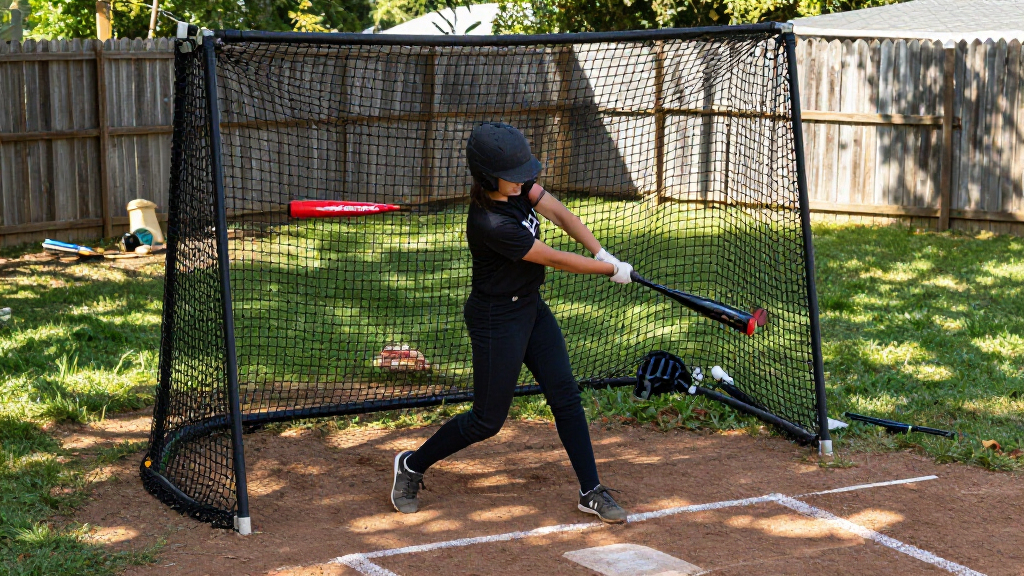
I evaluated each net against four factors that actually determine long-term satisfaction with softball hitting nets: frame stability, netting durability, setup and portability, and accessory value. Frame stability was weighted heaviest — a net that tips over or twists after every fifth swing stops getting used. I looked at frame geometry (bow frames versus square tubing), ground stakes, base width, and how each design handles off-center contact. Netting was judged on material, knot construction, and how well the net absorbed rather than rebounded softballs at pitching speed.
Setup and portability covered fold-down time, carry bag quality, and realistic weight for moving between car and field. Accessory value asked whether bundled tees, strike zones, and training balls were genuinely usable or just marketing padding. Products ranked higher when they delivered a complete, durable hitting station for the money; cheaper nets weren’t penalized for lacking extras, but were penalized for flimsy frames and thin netting that fail within a season of regular team use.
Factors to Consider When Choosing Softball Hitting Nets
Before buying a softball hitting net, it helps to understand what actually separates a $60 net from a $150 one — and where the differences don’t matter. These are the factors I’d weigh before clicking buy, plus the mistakes I see buyers make most often.
Frame Design Matters More Than Net Size
The single biggest complaint across this category is nets tipping or twisting, and it almost always traces back to frame geometry rather than net dimensions. Bow-frame designs curve the frame backward, which shifts the center of gravity behind the impact zone and lets the net absorb energy instead of transferring it to the legs. Square steel frames are cheaper to manufacture but tend to rock on hard swings, especially on concrete or packed dirt where stakes can’t be used. If you’re shopping for a young player doing soft toss, frame design barely matters. For a high school hitter taking full swings off a tee or against front toss, it’s the difference between a net that lasts years and one that frustrates everyone by midseason. Also check whether ground stakes are included — they’re cheap, but they’re the fix for most wind and stability problems.
Netting Material and Thickness
Netting is where budget manufacturers cut corners, and it’s the part you can’t easily replace. Look for polyethylene (PE) or nylon netting with knotted construction rather than knotless polyester blends, which stretch out and fray at attachment points after a few weeks of machine pitching or live arm speed. Denier and ply ratings are inconsistently advertised, so a practical proxy is warranty length and how the net attaches to the frame — sewn sleeves hold up better than clip systems that concentrate stress on single points. One common mistake: buying based on the frame photo alone. Two visually identical 7×7 nets can have dramatically different netting, and the cheaper one often becomes a backyard decoration within a season. If the net will mainly catch tee work and soft toss, mid-grade netting is fine; save the premium spend for pitching-speed use.
Size: Bigger Isn’t Automatically Better
A 7×7 footprint has become the category standard because it catches most mishit balls from tee work and front toss, but that doesn’t make it the right size for everyone. Younger players and confined spaces can get full value from a 6×6 net that folds smaller, weighs less, and sets up faster — a real advantage for travel families hauling gear to practices. The step up to 8×8 makes sense mainly if you’re doing live pitching drills, hitting off-speed locations, or working with multiple athletes who won’t always center the ball. Also measure your space honestly: a 7×7 net needs roughly ten feet of clear depth behind it for safe ball rebound and frame balance. Buyers frequently underestimate this and end up with a net crammed against a fence that gets hammered from behind.
Bundled Accessories: What’s Actually Worth It
Most nets in this price range ship with extras, and the value varies enormously. An attached or hanging strike zone target is genuinely useful — it turns random swings into deliberate pitch-recognition training and costs little to include. A collapsible batting tee is the next most valuable add, though bundled tees are usually lighter-duty than a standalone tee you’d buy separately, so treat them as a starting point rather than the end product. Ball caddies and target sheets are the most common filler; they inflate the perceived bundle value without changing how you train. My advice: price the net alone, then price the bundle. If the accessories cost less than $20–$30 over the bare net, the bundle usually wins. If the premium is steeper, buy the bare net and spend the difference on a quality tee.
Portability and Storage Reality Check
Every net in this category claims ‘portable,’ but the real-world experience ranges from a two-minute fold-and-bag to a ten-minute wrestling match with elastic cords. Count the frame pieces — fewer segments mean faster setup but a longer packed length, which matters if you’re fitting it into a sedan trunk rather than an SUV. Carry bag quality is a quiet differentiator: bags with full zippers and shoulder straps survive a season of team transport, while drawstring sacks rip at the seams within weeks. If the net will live permanently in a backyard, ignore all of this and prioritize frame weight and stability instead. But if you’re a coach or travel parent moving the net weekly, setup time and packed size should influence your choice nearly as much as hitting surface. This is exactly why a compact 6×6 net can beat a bigger model for certain buyers despite the smaller strike area.
Common Buying Mistakes to Avoid
The most expensive mistake in this category is paying twice: buying a barebones $50 net, watching the frame bend or netting fail, then buying the mid-range model you should have purchased first. Another frequent error is ignoring duplicate listings — several identical PowerNet and GoSports configurations appear under different SKUs and prices, so a quick comparison between listings often saves real money on the exact same hardware. Buyers also routinely overestimate accessory needs; a beginner doing tee work three times a week needs a stable frame and decent netting, not the biggest bundle on the page. Finally, don’t skip the warranty and parts question. Frames bend and nets tear — manufacturers that sell replacement parts or back their frames with multi-year coverage protect your investment far better than a slightly lower sticker price.
Frequently Asked Questions
Will a softball hitting net also work for baseball practice?
Yes, in almost every case. Softballs are larger and heavier than baseballs, so a net built to absorb softball impact handles baseballs easily — the reverse isn’t always true, which is why buying a dual-sport net like the PowerNet or GoSports 7×7 models is the safer route. The one spec to check is the strike zone attachment if your net includes one, since softball and baseball strike zones sit at different heights and shapes. If you’re training both sports in a family or team setting, look for adjustable or interchangeable targets rather than a fixed one. Beyond that, frame stability, netting, and setup are identical between the two uses, so there’s no reason to buy separate equipment.
Is a 7×7 net big enough, or should I step up to 8×8?
For tee work, soft toss, and front toss, a 7×7 net catches everything a reasonably controlled swing produces, which is why it’s the category standard and the size of most of my top picks. The 8×8 upgrade earns its price only in specific situations: live batting practice against a pitcher or machine, working deliberately on outside pitches, or coaching multiple hitters whose contact points vary widely. An 8×8 frame is also heavier, takes longer to set up, and needs more storage space, so it’s a real downgrade for travel and small yards. My general guidance is that beginners and intermediate players almost never outgrow 7×7, while serious travel and high school players doing live at-bats benefit from the extra margin. If you’re unsure, put the budget difference toward better netting or a quality tee instead.
How do I stop my hitting net from tipping over in the wind?
Start with the included ground stakes — most nets ship with them and most buyers never use them, even though they solve the majority of tipping problems on grass or dirt. On concrete or a garage floor where stakes won’t work, weight the rear frame legs with sandbags or repurposed weight plates, since the back of the frame is where the tipping force concentrates. Bow-frame designs like the PowerNet and GoSports models resist wind better inherently because their curved shape sheds gusts rather than catching them like a sail. If your yard is consistently windy, positioning the net so the frame’s narrow edge faces the prevailing direction also helps considerably. As a last resort, angling the net slightly into the wind reduces the effective surface area it presents.
Are the batting tees bundled with these nets any good?
Bundled tees are serviceable for tee work but generally lighter-duty than a standalone tee you’d buy separately — expect thinner rubber, smaller base plates, and less height adjustment range. For a beginner or a young player building swing fundamentals, the bundled tee does the job fine and represents good value since it effectively costs $20–$30 within the bundle. Where they fall short is durability under daily team use and stability on full-power swings from older players, where the base moves or the stem loosens over time. My suggestion is to start with the bundle, and if the tee becomes the weak link after a season, upgrade it separately while keeping the net. That path costs less overall than buying a premium net-and-tee package up front.
How long should a softball hitting net last, and can I replace parts?
A mid-range net used a few times per week should last two to four years, with netting usually failing before the frame — typically fraying at the attachment points or stretching out from repeated impact in the strike zone area. Premium PE netting with knotted construction and sewn sleeve attachments tends toward the longer end, while budget polyester blends may show wear within a single season of pitching-speed use. On parts: this is where established brands pull ahead, as PowerNet and GoSports sell replacement nets and frame components directly, while many generic imports don’t, effectively making the net disposable once anything breaks. Before buying, a quick check for replacement net availability can double the practical lifespan of your purchase. Store the net out of UV sunlight when possible, since sun exposure degrades netting faster than hitting does.
Conclusion
The right softball hitting net depends less on specs and more on how you’ll actually use it. For most buyers, the PowerNet 7×7 with Accessories is my best overall pick — its bow-frame stability, durable netting, and genuinely useful bundle make it a complete hitting station that lasts. If budget is the priority, the VEVOR kit with target, tee, and carry bag is the best value, delivering nearly the full accessory experience at a lower price, while the GoSports PRO variant is the premium choice for players who want the toughest netting and frame in the lineup for daily, high-velocity use.
Beginners and young players are well served by the simpler 7×7 options like the BAGAIL or the basic steel-frame kits — stability and net quality matter more than extras at this stage. Travel families and coaches should choose the 6×6 compact net with caddy and tee for its folding speed and trunk-friendly size, while anyone doing live pitching drills or sharing the net across a team gets the most from the 8×8 configuration or the blocking-system net built for cage-style volume. Whatever you choose, buy around frame stability first, netting second, and accessories last — that order consistently separates the nets that get used from the ones that get returned.
Halloween Picks
halloween
As an affiliate, we earn on qualifying purchases.