Softball catcher’s gear bags need to hold bulky protective equipment without becoming a burden between the car, field, and dugout. My best overall pick is the PowerNet Optimus Rolling Catcher’s Gear Bag for buyers prioritizing wheeled transport, while the Fanwoli 100L bag stands out for its large capacity and five-hook dugout organizer. The Easton Jen Schro backpack is a more compact carry-style alternative for players who would rather avoid a rolling bag. The main tradeoff is between roomy storage and easy transport: a bigger bag can fit more, but its size and weight may be harder to manage. Read on for how the full lineup compares and which style best fits your gear and routine.

Get sports gear delivered free with Prime
- Fast, free delivery on millions of items
- Prime Video, Amazon Music and more included
- Member-only deals all year
Complete the kit


Key Takeaways
- Wheels are a meaningful advantage when a full catcher’s kit, helmet, and extra items make shoulder carry tiring; rolling designs make up much of this lineup.
- Capacity does not tell the whole story: the Fanwoli pairs a 100L claim with five dugout hooks, while buyers should still check whether the layout suits their particular gear.
- Backpacks and duffels fill different needs from large wheeled bags: the Easton Jen Schro backpack and Easton E100G duffle favor a different carry format over maximum rolling-bag capacity.
- Several names repeat in the lineup. The FOKDUVB and KAVIGOR entries appear twice, so shoppers should compare the exact listing and included features rather than assume repeated branding means a different design.
- Hybrid and equipment-bag formats broaden the choice: Rawlings MACH Hybrid and Covert options may suit buyers who want a more flexible equipment carry style than a dedicated oversized catcher’s bag.
| FOKDUVB Baseball and Softball Catcher Gear Bag |  | Best Lightweight Carry Pick | Capacity: 45 liters | Dimensions: 13.8 x 9.4 x 21.7 in | Weight: 2.2 lbs | VIEW LATEST PRICE | See Our Full Breakdown |
| Fanwoli 100L Rolling Baseball Catchers Gear Bag with 5-Hook Dugout Organizer |  | Best for Team Gear and Dugout Access | Capacity: 100 liters | Dimensions: 39.37 × 13.38 × 11.81 in | Material: 900D Oxford fabric | VIEW LATEST PRICE | See Our Full Breakdown |
| Rolling Baseball and Catcher’s Gear Bag with Wheels, Holds Up to 7 Bats |  | Best for Bat-Carrying Catchers | Capacity: 71 liters | Dimensions: 10.63 × 10.63 × 38.58 in | Material: Water-resistant 1680D Oxford fabric | VIEW LATEST PRICE | See Our Full Breakdown |
| AUROTIER 92L Rolling Baseball and Softball Gear Bag |  | Best for Rougher Field Routes | Capacity: 92 liters | Dimensions: 12.2 x 15 x 38.5 in | Material: Water-resistant polyester | VIEW LATEST PRICE | See Our Full Breakdown |
| KAVIGOR 90L Rolling Baseball and Softball Catcher’s Gear Bag |  | Best for Two Sets of Catcher Gear | Capacity: 90 liters | Material: Water-resistant polyester | Compartments: 10 total; 6 zippered | VIEW LATEST PRICE | See Our Full Breakdown |
| Easton E100G Team Equipment Duffle Bag |  | Best for Carrying Multiple Sets | Dimensions: 38 x 14 x 14 inches | Material: Diamond-embossed material | Main opening: Large U-shaped zipper opening | VIEW LATEST PRICE | See Our Full Breakdown |
| PowerNet Optimus Rolling Catcher’s Gear Bag |  | Best for Dugout Organization | Material: Heavy-duty fabric | Shell type: Soft | Handle: Telescopic | VIEW LATEST PRICE | See Our Full Breakdown |
| SPORJET Rolling Baseball and Softball Catchers Gear Bag |  | Best Four-Wheel Hauler | Material: Polyester | Color: Grey | Bat capacity: Up to 4 bats | VIEW LATEST PRICE | See Our Full Breakdown |
| Easton Jen Schro Fastpitch Softball Catcher’s Backpack |  | Best Carry-On-Your-Back Option | Material: Polyester | Capacity: 56 liters | Dimensions: 24 x 14 x 24 inches | VIEW LATEST PRICE | See Our Full Breakdown |
| AUROTIER Rolling Baseball Catchers Gear Bag with Wheels |  | Best for High-Capacity Storage | Capacity: 92 liters | Compartments: 4 | Zippered compartments: 8 | VIEW LATEST PRICE | See Our Full Breakdown |
| Easton Catcher’s Wheeled Baseball and Softball Bag |  | Best for Structured Organization | Type: Catcher’s equipment bag | Dimensions: 28.5 x 16 x 12 inches | Handle and wheels: Telescopic handle; inline wheels | VIEW LATEST PRICE | See Our Full Breakdown |
| KAVIGOR 90L Rolling Baseball and Softball Catchers Gear Bag |  | Best for Carrying Two Sets | Capacity: 90 liters | Material: Water-resistant polyester | Compartments: 10 total, including 6 zippered compartments | VIEW LATEST PRICE | See Our Full Breakdown |
| FOKDUVB Baseball and Softball Catcher’s Gear Bag |  | Best Backpack for Solo Catchers | Capacity: 45 liters | Dimensions: 13.8 x 9.4 x 21.7 inches | Weight: 2.2 lb | VIEW LATEST PRICE | See Our Full Breakdown |
| Rawlings Covert Baseball and Softball Duffle Equipment Bag |  | Best Compact Duffle | Capacity: 26 liters | Dimensions: 26 x 13 x 13 inches | Weight: 2.1 lb | VIEW LATEST PRICE | See Our Full Breakdown |
| Rawlings MACH Hybrid Baseball and Softball Equipment Bag |  | Best Hybrid Carry Option | Style: Backpack/duffle hybrid | Dimensions: 25 x 15 x 12 inches | Material: Water-resistant polyester | VIEW LATEST PRICE | See Our Full Breakdown |
| softball catcher’s gear bag | Material | Compartments | Capacity | Dimensions |
|---|---|---|---|---|
| FOKDUVB Baseball and Softball | Water-resistant 600D polyester | 5 | 45 liters | 13.8 x 9.4 x 21.7 in |
| Fanwoli 100L Rolling Baseball | 900D Oxford fabric | 3 | 100 liters | 39.37 × 13.38 × 11.81 in |
| Rolling Baseball and Catcher’s | Water-resistant 1680D Oxford fabric | 5 zippered compartments | 71 liters | 10.63 × 10.63 × 38.58 in |
| AUROTIER 92L Rolling Baseball | Water-resistant polyester | 4 | 92 liters | 12.2 x 15 x 38.5 in |
| KAVIGOR 90L Rolling Baseball a | Water-resistant polyester | 10 total; 6 zippered | 90 liters | — |
| Easton E100G Team Equipment Du | Diamond-embossed material | — | — | 38 x 14 x 14 inches |
| PowerNet Optimus Rolling Catch | Heavy-duty fabric | 8 | 7 (as listed) | — |
| SPORJET Rolling Baseball and S | Polyester | 3 | — | — |
| Easton Jen Schro Fastpitch Sof | Polyester | 7 | 56 liters | 24 x 14 x 24 inches |
| AUROTIER Rolling Baseball Catc | Polyester | 4 | 92 liters | 12.2 x 15 x 38.5 inches |
| Easton Catcher’s Wheeled Baseb | — | — | — | 28.5 x 16 x 12 inches |
| KAVIGOR 90L Rolling Baseball a | Water-resistant polyester | 10 total, including 6 zippered compartments | 90 liters | — |
| FOKDUVB Baseball and Softball | Water-resistant 600D polyester | 4 | 45 liters | 13.8 x 9.4 x 21.7 inches |
| Rawlings Covert Baseball and S | Polyester body with vinyl bottom | — | 26 liters | 26 x 13 x 13 inches |
| Rawlings MACH Hybrid Baseball | Water-resistant polyester | 1 main compartment | — | 25 x 15 x 12 inches |
More Details on Our Top Picks
FOKDUVB Baseball and Softball Catcher Gear Bag
The FOKDUVB is the most manageable choice here for a player who wants a full catcher’s kit without hauling a wheeled trunk. Its 45-liter capacity accommodates core protective gear, while sleeves for four bats and a ventilated cleat pocket keep key items sorted. At 2.2 pounds, it is far easier to lift into a car than the 90- and 100-liter rolling options from KAVIGOR and Fanwoli. Padded adjustable straps and a luggage strap also suit trips between field and home. The tradeoff is carrying everything on your back: it has no wheels, and the leg-guard straps fit only equipment up to 6.5 inches wide. I’d choose it for a player with one kit, not a team hauling several sets.
Pros:- 45-liter capacity fits catcher equipment and accessories
- Four bat sleeves separate bats from protective gear
- Ventilated shoe pocket fits cleats up to US size 14
- Padded straps, fence hook, and luggage strap support carrying and travel
Cons:- No wheels, so a loaded bag must be carried
- Leg-guard strap compatibility is limited to gear up to 6.5 inches wide
Best for: Players carrying one catcher’s set who want a relatively light bag with bat sleeves and a ventilated cleat pocket.
Not ideal for: Players transporting multiple sets or heavy equipment over long distances, since this bag has no wheels and less capacity than the rolling picks.
- Capacity:45 liters
- Dimensions:13.8 x 9.4 x 21.7 in
- Weight:2.2 lbs
- Material:Water-resistant 600D polyester
- Compartments:5
- Bat capacity:Up to 4 bats
- Shoe pocket:Ventilated; fits cleats up to US size 14
- Sport:Baseball and softball
Our verdict“Choose the FOKDUVB if you want a lighter, non-wheeled bag for one player’s gear rather than the hauling capacity of a rolling model.”
Fanwoli 100L Rolling Baseball Catchers Gear Bag with 5-Hook Dugout Organizer
When a catcher’s bag also needs to serve as a shared gear station, the Fanwoli 100L has the clearest advantage in this group. Its five internal hooks let players hang equipment at the dugout fence for quick access, while two removable dividers help separate items inside the large main space. Eight bat sleeves and wet/dry storage make it better suited to team use than the individual-focused FOKDUVB, which is lighter but holds less. All-terrain wheels and reflective strips help with transport and visibility, and the vented shoe compartment keeps footwear apart from other gear. The scale is the drawback: at nearly 39 inches long, it may be awkward to store or move through tight spaces. I’d pick it for a team or catcher with a lot to carry, not a player with a compact kit.
Pros:- 100-liter capacity and removable dividers allow flexible gear storage
- Eight bat sleeves and five internal hooks support team-style organization
- All-terrain wheels aid transport with a heavy load
- Vented shoe storage and wet/dry pockets separate used items
Cons:- Large dimensions may complicate storage and transport
- Its capacity and organizer features may be excessive for a single player’s kit
Best for: Teams and catchers who carry several bats, multiple gear pieces, and want equipment hanging within reach in the dugout.
Not ideal for: Players with limited car or home storage, or those carrying only one set of gear, because its 100-liter size can be cumbersome.
- Capacity:100 liters
- Dimensions:39.37 × 13.38 × 11.81 in
- Material:900D Oxford fabric
- Bat sleeves:8
- Compartments:3
- Dividers:2 removable
- Hooks:5 internal hooks
- Wheels:2 spinner wheels
- Warranty:1-year replacement service
Our verdict“Pick the Fanwoli when high capacity and fence-side organization matter more than compact storage.”
Rolling Baseball and Catcher’s Gear Bag with Wheels, Holds Up to 7 Bats
This rolling bag earns its place for catchers who bring a large bat selection along with their protective gear. The seven-bat capacity is the standout difference: it exceeds the four-bat storage in the AUROTIER and FOKDUVB, while its 71-liter interior stays below the bulkier Fanwoli. A removable hard-board divider gives gear some separation, and the ventilated, foil-lined shoe compartment keeps cleats apart from cleaner items. The 1680D Oxford fabric, reinforced handles, and wear-resistant base are useful choices for a bag likely to be loaded and rolled often. Its long, narrow shape may be harder to store than a more compact bag, however, and the non-detachable shoulder strap may get in the way when using the wheels. This suits bat-heavy players more than those prioritizing easy storage.
Pros:- Holds up to seven bats, more than the four-bat FOKDUVB and AUROTIER
- Removable hard-board divider separates equipment
- Ventilated, foil-lined shoe compartment isolates cleats
- 1680D Oxford fabric, reinforced handles, and wear-resistant base support frequent transport
Cons:- Long dimensions can make storage awkward
- Shoulder strap is non-detachable
Best for: Catchers who regularly carry several bats alongside their helmet, protective gear, and cleats.
Not ideal for: Players with limited storage space or those who want to remove the shoulder strap when rolling the bag.
- Capacity:71 liters
- Dimensions:10.63 × 10.63 × 38.58 in
- Material:Water-resistant 1680D Oxford fabric
- Bat capacity:Up to 7 bats
- Compartments:5 zippered compartments
- Wheels:2
- Shoe compartment:Ventilated, foil-lined
- Divider:Removable hard board
Our verdict“Choose this model if carrying up to seven bats is a priority and you can accommodate its long profile.”
AUROTIER 92L Rolling Baseball and Softball Gear Bag
The AUROTIER makes the most sense for players who roll their gear across more than smooth parking lots. Its pneumatic wheels are designed for varied surfaces, giving it a specific transport advantage over the standard two-wheel setup on the 71-liter rolling bag. With 92 liters of capacity, four bat slots, a ventilated shoe compartment, and four side pockets, it has room for a full catcher’s kit without reaching the Fanwoli’s 100-liter scale. The telescoping handle and fence hook also make moving it to the dugout and organizing gear there more straightforward. The compromise is bulk: at 38.5 inches long, it may be awkward to store or lift when stairs are involved. I’d favor it for players who need rolling capacity and varied-surface mobility, not those seeking a compact carry bag.
Pros:- Pneumatic wheels are designed for varied surfaces
- 92-liter capacity accommodates a substantial equipment load
- Four bat slots, shoe compartment, and four side pockets organize gear
- Telescoping handle and fence hook aid field transport and dugout setup
Cons:- Long, large form can be cumbersome to store or carry
- The available product information does not establish long-term durability
Best for: Catchers who roll a full kit over uneven paths and want dedicated bat, shoe, and side-pocket storage.
Not ideal for: Players with tight storage, frequent stairs, or a preference for a lighter bag they can carry on their back.
- Capacity:92 liters
- Dimensions:12.2 x 15 x 38.5 in
- Material:Water-resistant polyester
- Compartments:4
- Zippered compartments:8
- Bat capacity:4 bats
- Wheel type:Pneumatic
- Features:Bottle holder, shoe compartment, telescoping handle, fence hook
Our verdict“Choose the AUROTIER if field paths call for pneumatic wheels and you have room to store a large rolling bag.”
KAVIGOR 90L Rolling Baseball and Softball Catcher’s Gear Bag
For a catcher who shares a bag or needs to move two complete sets, the KAVIGOR 90L is the most purpose-built option in this group. Its stated capacity for two sets of catcher’s gear, paired with ten compartments, gives it a clearer multi-kit role than the AUROTIER, which emphasizes four bat slots and all-terrain wheels. Dedicated glove and shoe spaces, bat sleeves, and a deployable helmet hood help keep bulky protective items and smaller accessories from becoming one pile. Reinforced panels and a water-resistant shell add practical protection, while the two-year manufacturer warranty is a useful ownership detail. The tradeoff is size: a single-kit player may find the 90-liter capacity more bag than needed. Its 3.5-inch inline wheels also differ from the AUROTIER’s pneumatic wheels, which are designed for varied surfaces.
Pros:- Designed to carry two sets of catcher’s gear
- Ten compartments include dedicated spaces for gloves, shoes, and bats
- Deployable helmet hood provides a separate place for helmet storage
- Water-resistant polyester, reinforced panels, and a two-year manufacturer warranty
Cons:- 90-liter capacity may be excessive for a player carrying one set
- 3.5-inch inline wheels may be less suited to varied surfaces than the AUROTIER’s pneumatic wheels
Best for: Catchers, siblings, or team staff who need to transport two sets of protective gear and keep accessories sorted.
Not ideal for: Players carrying one compact set who want a small bag, or those frequently rolling over rough ground and preferring pneumatic wheels.
- Capacity:90 liters
- Material:Water-resistant polyester
- Compartments:10 total; 6 zippered
- Wheels:2 inline wheels, 3.5 inches
- Features:Glove compartment, shoe compartment, helmet hood, bat sleeves, bottle holder, phone holder, telescoping handle
- Sport:Baseball and softball
- Warranty:2 years
- Model:KA-LFL0027-R
Our verdict“Choose the KAVIGOR if two sets of catcher gear and compartmentalized storage matter more than keeping the bag compact.”
Easton E100G Team Equipment Duffle Bag
The Easton E100G is the straightforward choice when a team needs to move more than one catcher’s setup at once. Its 38-inch main compartment can fit multiple helmets or two sets of catcher’s gear, making it more suited to shared team transport than the individual-player organization offered by the Easton Jen Schro backpack. A large U-shaped opening gives a wide access point for bulky pads, while reinforced straps and lockable zippers add useful durability and security for travel. The tradeoff is its simple duffle format: it has no wheels or listed separate compartments for shoes and smaller accessories, so gear may need to be packed in smaller bags inside. Choose it for carrying capacity, not easy organization or hands-free hauling.
Pros:- Main compartment can accommodate multiple helmets or two sets of catcher’s gear
- Wide U-shaped zipper opening helps with loading bulky protective equipment
- Diamond-embossed material is designed for durable gear storage
- Reinforced straps and lockable zippers suit team travel
Cons:- No wheels, so a heavily loaded bag must be carried
- No dedicated compartments are specified for shoes or smaller accessories
Best for: Coaches or teams transporting multiple helmets or up to two catcher’s gear sets in one bag
Not ideal for: Individual players who need wheels, dedicated cleat storage, or separate compartments to keep equipment organized
- Dimensions:38 x 14 x 14 inches
- Material:Diamond-embossed material
- Main opening:Large U-shaped zipper opening
- Gear capacity:Multiple helmets or two sets of catcher’s gear
- Straps:Reinforced
- Zippers:Lockable
Our verdict“Pick the E100G when shared capacity matters more than wheels and compartment-by-compartment organization.”
PowerNet Optimus Rolling Catcher’s Gear Bag
The PowerNet Optimus earns its place for players who want their equipment organized at the field, not simply hauled in one large compartment. Its adjustable shelves and eight compartments help separate catcher’s gear from gloves and other accessories, while ventilated cleat storage gives shoes their own space. The telescopic handle and rolling design reduce the burden of carrying a full kit, and five fence hooks let players hang the bag rather than leave it on the ground. Compared with the simpler Easton E100G, this is the more organized field-side setup, but it is less suited to carrying multiple sets of gear in one open space. The stated recommendation for ages 12 and older also makes it a less direct fit for younger players.
Pros:- Adjustable shelves and multiple compartments support organized packing
- Ventilated cleat compartment separates shoes from other equipment
- Telescopic handle and wheels reduce the need to carry the loaded bag
- Five fence hooks keep the bag off the ground at the field
Cons:- Recommended for ages 12 and older, limiting its fit for younger players
- Compartment-focused design is less suited to carrying multiple sets in one open space
Best for: Players aged 12 and older who want rolling transport and separate storage for catcher’s gear, cleats, and accessories
Not ideal for: Younger players or teams needing a basic, open duffle for carrying multiple gear sets
- Material:Heavy-duty fabric
- Shell type:Soft
- Handle:Telescopic
- Wheels:Roller
- Compartments:8
- Capacity:7 (as listed)
- Fence hooks:5
- Recommended age:12 years and older
Our verdict“Choose the Optimus for a player aged 12 or older who values dugout organization and rolling transport.”
SPORJET Rolling Baseball and Softball Catchers Gear Bag
The SPORJET rolling bag is a practical pick for players who bring bats along with a full catcher’s kit and want wheels that can roll in more than one direction. Its four inline wheels and telescopic handle make transporting the load easier than carrying the Easton Jen Schro backpack, while separate spaces for shoes, a helmet, and other gear help prevent everything from becoming one packed bundle. Capacity for up to four bats adds value for players who carry their own bats or extra team equipment. The reinforced back panel is intended to help the bag stay upright. The main limitation is planning around its size: the description calls it large but gives no dimensions or weight, so storage fit and loaded handling are harder to judge before buying.
Pros:- Holds up to four bats alongside catcher’s equipment
- Separate compartments organize shoes, helmet, and other gear
- Four inline wheels and a telescopic handle support rolling transport
- Reinforced back panel helps the bag stay upright
Cons:- Large size may be cumbersome to store
- Dimensions and weight are not provided, making storage and handling harder to judge
Best for: Players who carry catcher’s gear and up to four bats and prefer a wheeled bag with separate gear spaces
Not ideal for: Buyers with limited storage who need stated dimensions and weight before choosing a bag
- Material:Polyester
- Color:Grey
- Bat capacity:Up to 4 bats
- Compartments:3
- Wheels:4 inline wheels
- Handle:Telescopic pull handle
- Closure:Zipper
- Model number:AM832B-Grey
Our verdict“Choose the SPORJET if four-wheel transport and bat capacity matter more than having precise size information upfront.”
Easton Jen Schro Fastpitch Softball Catcher’s Backpack
For a fastpitch catcher who would rather carry gear than pull it, the Easton Jen Schro backpack offers unusually thoughtful separation. The vented main compartment has an interior shelf, and a separate vented cleat compartment keeps shoes apart from pads. Two lined bat sleeves and fold-away mesh leg-guard sleeves add useful storage without requiring a separate bat bag. Unlike the wheeled SPORJET, this Easton has no wheels, so the full load stays on the player’s shoulders; its 24-inch height may also feel bulky when worn or carried. The fence hook and external attachment strap give it convenient field-side utility, but this design makes the most sense for players who prioritize hands-free backpack transport and organized fastpitch storage over rolling comfort.
Pros:- Vented main and cleat compartments separate catcher’s gear from shoes
- Interior shelf helps organize equipment inside the main compartment
- Two lined bat sleeves and fold-away mesh leg-guard sleeves add dedicated storage
- Fence hook and external strap help manage gear at the field
Cons:- No wheels, so the player must carry the loaded bag
- 24-inch height may feel bulky to carry
Best for: Fastpitch catchers who want vented, separated storage and prefer a backpack over a wheeled bag
Not ideal for: Players carrying a heavy full kit over long distances or those who want rolling transport
- Material:Polyester
- Capacity:56 liters
- Dimensions:24 x 14 x 24 inches
- Compartments:7
- Bat sleeves:2 fully lined sleeves
- Wheels:None
- Color:White
- Warranty:1-year limited warranty
Our verdict“Choose this backpack if you value organized fastpitch storage and can comfortably carry your catcher’s gear.”
AUROTIER Rolling Baseball Catchers Gear Bag with Wheels
The AUROTIER 92-liter bag is aimed at catchers who pack a full kit plus extras and want a large wheeled format that can fold away after the season. Its four compartments and eight zippered compartments offer more separation than the open storage of the Easton E100G, and the sleeve for four bats keeps long gear together. A ventilated shoe compartment, bottle holder, phone holder, and fence hook make it easier to manage a full day at the field. The reinforced base and two rugged wheels are suited to hauling equipment, though the bag is described as water resistant rather than waterproof. The listed weight of 16 ounces is worth checking against the intended load, since it may not reflect how the packed bag will feel.
Pros:- 92-liter capacity and multiple compartments accommodate a substantial equipment load
- Bat sleeve holds up to four bats
- Ventilated shoe compartment separates footwear from other gear
- Reinforced base, rugged wheels, and foldable design support transport and storage
Cons:- Water-resistant shell is not described as fully waterproof
- Listed weight of 16 ounces may not convey the handling feel of a loaded bag
Best for: Catchers who carry a full equipment set, up to four bats, and field-day accessories in one organized rolling bag
Not ideal for: Players who need waterproof protection or prefer a small, lightweight bag for minimal gear
- Capacity:92 liters
- Compartments:4
- Zippered compartments:8
- Bat capacity:4
- Dimensions:12.2 x 15 x 38.5 inches
- Listed weight:16 ounces
- Material:Polyester
- Water resistance:Water resistant
- Wheels:2 rugged wheels
Our verdict“Pick the AUROTIER when you need high-capacity, compartmentalized rolling storage and can accept water resistance rather than waterproofing.”
Easton Catcher’s Wheeled Baseball and Softball Bag
I’d choose the Easton Catcher’s Wheeled Bag for players who want a rigid, organized home for a full set of catcher’s gear. Its firm base and back help the large bag hold its shape, while the telescopic handle and inline wheels reduce the burden of moving bulky equipment across a parking lot or dugout. Three ventilated compartments, expandable leg-guard sleeves, and two detachable shelves give it more built-in sorting than the simpler Rawlings Covert Duffle. The tradeoff is its 28.5 x 16 x 12-inch footprint: it may be awkward to store in a crowded garage or transport when the wheels aren’t practical. I’d also avoid assuming it is lightweight, since no weight or material details are provided. Its organization is the main reason to choose it, not compactness.
Pros:- Rigid base and back help support the bag when loaded.
- Telescopic handle and inline wheels make equipment easier to move.
- Three mesh-vented compartments and detachable shelves provide flexible organization.
- Expandable leg-guard sleeves and lined bat sleeves keep key equipment separate.
Cons:- Large dimensions may make storage and tight dugout spaces difficult.
- Weight and material details are not provided, so carrying comfort and fabric durability are harder to judge.
Best for: Catchers who want a wheeled bag with separate spaces for protective gear, bats, and personal items, and who have room to store a full-size bag.
Not ideal for: Players with limited storage space or routes where they regularly need to carry the bag up stairs; its large dimensions and wheeled format may be inconvenient.
- Type:Catcher’s equipment bag
- Dimensions:28.5 x 16 x 12 inches
- Handle and wheels:Telescopic handle; inline wheels
- Ventilated compartments:3 mesh-vented compartments
- Leg-guard sleeves:2 expandable sleeves
- Bat storage:2 lined sleeves with integrated fence hooks
- Internal organization:2 detachable shelves
- Personal-item storage:Felt-lined pocket, internal mesh pocket, and removable personal-item bag
Our verdict“Choose the Easton if organized, wheeled transport matters more than keeping your catcher’s gear bag compact.”
KAVIGOR 90L Rolling Baseball and Softball Catchers Gear Bag
For a family or team sharing equipment transport, the KAVIGOR 90L Rolling Bag has a different purpose from the Easton: its headline advantage is space for two sets of catcher gear, rather than a rigid structure with detachable shelves. Ten compartments, including dedicated shoe and glove storage, help keep that large load sorted, and the deployable helmet hood adds a separate place for bulky headgear. Its 3.5-inch wheels are described as all-terrain, which may help when moving a heavily loaded bag over uneven ground. The tradeoff is the bag’s substantial 90-liter capacity: it can be more bag than a single player needs and takes up considerable storage room. I’d favor the FOKDUVB backpack for one catcher who carries gear themselves, but choose this KAVIGOR when shared capacity and rolling transport matter most.
Pros:- 90-liter capacity is designed to hold two sets of catcher gear.
- Ten compartments include dedicated glove and shoe storage.
- Two 3.5-inch wheels and a telescoping handle support rolling transport.
- Water-resistant polyester and a two-year protection plan are specified.
Cons:- The large capacity can make the bag difficult to store and manage when fully loaded.
- Its rolling design is less convenient than a backpack when stairs or frequent lifting are part of the route.
Best for: Parents or team staff transporting two players’ catcher sets, plus bats and other equipment, in one rolling bag.
Not ideal for: A single youth catcher with limited storage space or a lightweight carry routine; the 90-liter capacity may be unnecessarily bulky.
- Capacity:90 liters
- Material:Water-resistant polyester
- Compartments:10 total, including 6 zippered compartments
- Wheels:2 inline wheels, 3.5 inches
- Handle:Telescoping
- Features:Deployable helmet hood, shoe compartment, bottle holder, and phone holder
- Color:Black
- Warranty:2 years
Our verdict“Pick the KAVIGOR when one rolling bag needs to carry two catcher sets; for a single player, its capacity may be excessive.”
FOKDUVB Baseball and Softball Catcher’s Gear Bag
The FOKDUVB Catcher’s Gear Bag is the most carry-friendly choice here for a player who wants a backpack rather than a wheeled hauler. Its 45-liter capacity is listed to fit a helmet, chest protector, leg guards, cleats, and up to four bats, while padded shoulder straps, a chest strap, and a luggage strap give players several ways to manage the load. A ventilated shoe pocket that fits cleats up to US size 14 helps separate footwear from the rest of the kit. Compared with the 90-liter KAVIGOR, it is more practical for one catcher traveling with their own equipment, though it cannot match that bag’s two-set capacity or wheels. Check the leg-guard straps before buying: they extend only to 6.5 inches wide, and this backpack offers no rolling option.
Pros:- 45-liter capacity is designed for a full catcher’s set and up to four bats.
- Padded shoulder straps and a chest strap support backpack carrying.
- Ventilated shoe pocket fits cleats up to US size 14.
- Water-resistant 600D polyester, fence hook, and luggage strap add practical transport features.
Cons:- No wheels, so a fully loaded bag must be carried.
- Leg-guard straps extend only to 6.5 inches wide, which may not fit every player’s equipment.
Best for: Youth or adult catchers who carry one full set of gear themselves and want backpack straps, bat storage, and a ventilated cleat compartment.
Not ideal for: Players who need wheels for a heavy load, or catchers whose leg guards exceed the stated 6.5-inch strap width.
- Capacity:45 liters
- Dimensions:13.8 x 9.4 x 21.7 inches
- Weight:2.2 lb
- Material:Water-resistant 600D polyester
- Compartments:4
- Bat capacity:Up to 4 bats
- Cleat capacity:Up to US size 14
- Straps and features:Adjustable padded shoulder straps, chest strap, ventilated shoe pocket, fence hook, and luggage strap
Our verdict“Choose this backpack for carrying one catcher’s full kit on your back, provided the leg-guard straps fit your gear.”
Rawlings Covert Baseball and Softball Duffle Equipment Bag
I’d shortlist the Rawlings Covert Duffle for players who want a straightforward bag for a lighter load, not a dedicated high-capacity catcher’s hauler. At 26 liters and 2.1 pounds, it is much more manageable than the Easton wheeled bag, while two bat sleeves and a ventilated shoe compartment separate a couple of important items from the main space. A durable vinyl bottom is intended to help protect gear from moisture, and the name card holder offers simple identification. The main compromise is its single large interior pocket: unlike the Easton’s shelves and multiple compartments, this layout gives less separation for bulky pads and smaller accessories. It also has no wheels. I’d pick it for a player with a compact kit or a secondary practice bag, but not for someone packing a full catcher’s set plus extras.
Pros:- Light 2.1-pound design is easier to carry than the larger wheeled options.
- Two bat sleeves keep bats separate from the main compartment.
- Ventilated shoe compartment helps isolate cleats.
- Vinyl bottom and name card holder add practical protection and identification.
Cons:- No wheels, so the bag must be carried by its shoulder straps.
- One main compartment offers less organization for bulky catcher equipment.
- 26-liter capacity may be limiting for a full catcher’s set and extra clothing.
Best for: Players with a smaller equipment load who want a light shoulder-carried duffle with separate bat and shoe storage.
Not ideal for: Catchers packing a full set of bulky protective gear and accessories who need extensive internal organization or wheels.
- Capacity:26 liters
- Dimensions:26 x 13 x 13 inches
- Weight:2.1 lb
- Material:Polyester body with vinyl bottom
- Bat storage:2 sleeves
- Other storage:Large interior pocket, mesh valuables pocket, and ventilated shoe compartment
- Straps:2 extra-long over-the-shoulder straps
- Color:Black
Our verdict“Choose the Covert for a compact, light duffle and skip it if your catcher’s kit needs a large, highly divided gear bag.”
Rawlings MACH Hybrid Baseball and Softball Equipment Bag
The Rawlings MACH Hybrid suits players who want one roomy bag that can be carried like a backpack or duffle, rather than rolled like the Easton. Its 25 x 15 x 12-inch body is listed as large enough for a full catcher’s set, with two bat sleeves, end-cap cleat storage, and a dedicated glove area to keep key items from disappearing into the main compartment. Fleece-lined side pockets offer a softer place for valuables, and the water-resistant polyester adds some protection in damp conditions. Compared with the smaller Rawlings Covert, the MACH is built around a full gear load, but its organization still centers on one main compartment. The product details do not specify a separate wheel system or multiple interior sections, so players who want shelves and extensive sorting may prefer the Easton.
Pros:- Main compartment is described as spacious enough for a full catcher’s set.
- Two bat sleeves, end-cap cleat storage, and a dedicated glove area separate key gear.
- Fleece-lined side pockets provide a softer space for valuables.
- Water-resistant polyester offers added protection in damp conditions.
Cons:- Only one main compartment is listed, limiting separation for bulky pads and accessories.
- No wheel system is specified, so buyers seeking rolling transport should look elsewhere.
- Dimensions may feel bulky for players carrying a smaller equipment load.
Best for: Catchers who want a full-set-capable bag with backpack/duffle flexibility and dedicated storage for bats, cleats, gloves, and valuables.
Not ideal for: Players who need a wheeled bag or several distinct compartments to separate every piece of protective equipment.
- Style:Backpack/duffle hybrid
- Dimensions:25 x 15 x 12 inches
- Material:Water-resistant polyester
- Compartments:1 main compartment
- Bat storage:2 sleeves
- Additional storage:End-cap cleat storage, dedicated glove area, and fleece-lined side pockets
- Closure:Zipper
- Strap:Adjustable
Our verdict“Choose the MACH for flexible carry and dedicated bat, cleat, and glove storage, but pick a more divided wheeled bag if organization is your priority.”
How We Picked
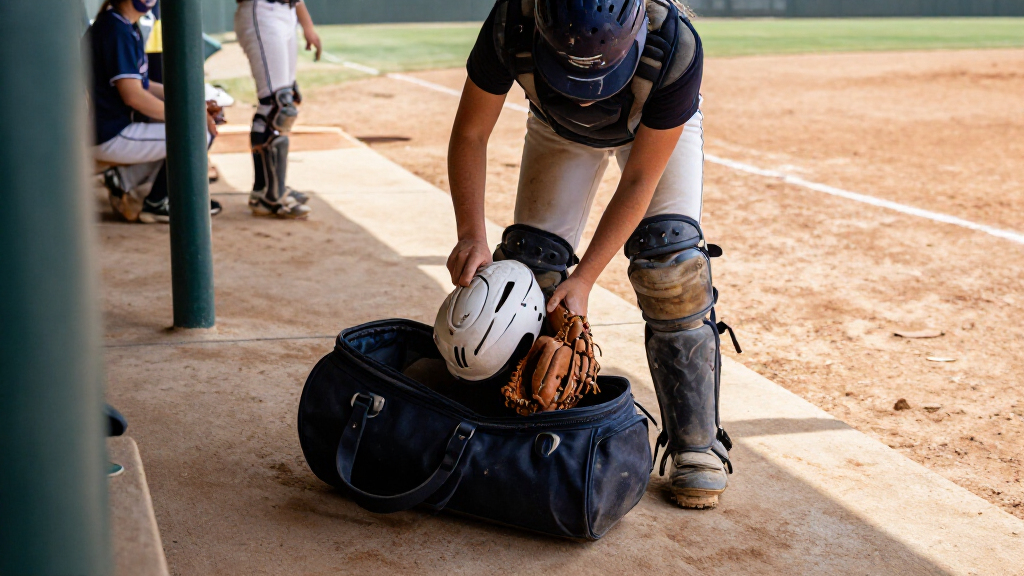
I ranked these softball catcher’s gear bags by how well their stated format and features address a catcher’s real transport and storage needs. I weighed usable capacity, mobility, organization, and carry style, giving particular attention to whether a bag is described as rolling, backpack-style, duffel-style, or equipped with dugout organization. I also considered whether the product’s stated purpose clearly accommodates catcher’s equipment rather than general team gear.
The order reflects the strength of that fit, not a claim that one bag suits every player. Options with a clear catcher-focused setup and useful mobility or organization rank ahead of more general equipment bags; compact or alternate carry formats earn a place for players who value those tradeoffs. Where product names repeat, I treat the listings as separate entries but advise checking the exact model details before buying. No single capacity figure or feature list guarantees a fit, so the guide and FAQs address how to check against your own gear.
Factors to Consider When Choosing Softball Catcher’s Gear Bags
Choosing among these bags is less about finding the biggest number and more about matching the bag to your equipment, commute, and team routine. I would check the details below before deciding between a rolling catcher’s bag, a backpack, or a general equipment duffel.
Measure Your Full Kit Before Choosing Capacity
A catcher’s kit can take up more room than a fielding player’s gear, especially when you pack a helmet, chest protector, leg guards, mitt, and personal items together. Lay out everything you expect to carry and compare it with the bag’s listed dimensions, not only its volume figure. A 90L or 100L label is useful for comparing claims, but the shape and placement of compartments affect what fits in practice. Avoid packing so tightly that zippers strain or wet gear cannot be separated. If you also carry team equipment, decide whether that belongs in this bag or a separate duffel. Fit the whole routine, not just the protective set, before choosing extra capacity.
Choose Wheels, Backpack Straps, or a Duffel for Your Route
Rolling bags can reduce the effort of carrying a heavy kit across parking lots and long paths, but wheels are less useful on stairs, rough ground, or crowded spaces. A backpack keeps both hands free and may be easier to carry through those settings, though the load sits on your shoulders. A duffel can be simple to lift into a vehicle, but its comfort depends on the handles and how much weight you put inside. Think through the route from home to the field, including stairs and dugout access. Buyers sometimes choose wheels based on capacity alone and overlook whether they can actually roll the bag where they play. Match the carry system to the route you travel most often.
Check Organization and Dugout Access
Separate pockets and hooks can make it easier to find small items and keep the dugout from turning into a pile of gear. The Fanwoli’s five-hook organizer is a clear example of a feature aimed at hanging equipment during a game, while other bags may prioritize enclosed storage instead. Before buying, decide which items need quick access and which can stay packed away. Hooks are only helpful if your team’s dugout has a suitable place to use them, and extra pockets do not automatically create a good layout. Check whether the bag description identifies compartments for the items you carry most often. Useful organization is about access and routine, not pocket count alone.
Plan for Wet or Dirty Equipment
Catchers often pack equipment that may be damp, dusty, or muddy after a game. A bag that keeps everything together can be convenient, but enclosing wet items with clean clothing may leave the whole load unpleasant to unpack. Look for clear information about separate compartments, ventilation, and cleaning instructions rather than assuming every gear bag handles moisture well. If those details are not specified, plan to air equipment out promptly and use a separate washable sack for damp items. Avoid leaving a packed bag in a hot vehicle for long periods. Maintenance habits matter as much as storage layout when gear goes back into the bag after play.
Check the Listing and the Bag’s Intended Use
This roundup includes catcher-specific products alongside general equipment duffels and hybrid bags, so the category label alone should not settle the decision. Confirm the dimensions, carry features, and intended use in the exact listing you are considering. This matters especially here because FOKDUVB and KAVIGOR product names each appear twice; repeated names may not indicate identical listings or included features. Do not assume that a bag described for baseball also fits your softball catcher’s equipment without checking its measurements. If the listing leaves a key detail unclear, compare it with your gear before buying. Verify the exact version and its stated capacity rather than relying on a familiar product name.
Know When to Pay for More Capacity or Features
Extra capacity is useful when you carry protective gear, practice items, and personal belongings in one bag, but a larger bag can take up more vehicle and dugout space. A simpler format may be a better fit if you pack only your own kit and value easier handling. A dedicated organizer feature can matter more than extra volume for a player who wants equipment accessible between innings. Premium positioning alone does not tell you whether the bag’s layout suits your routine, so compare the actual features with the way you pack. For a beginner, a straightforward bag that fits the core kit may be easier to manage than a large, highly loaded setup. Pay for capacity or organization you will use, not features that add bulk without solving a problem.
Frequently Asked Questions
How can I tell whether a listed capacity will fit my catcher’s equipment?
Start by laying out your helmet, chest protector, leg guards, mitt, and any extras you plan to carry, then compare their dimensions with the bag’s listed measurements. Volume figures such as 90L or 100L help with broad comparisons, but they do not show the shape of the main compartment or how much room pockets take up. Check for product details that describe how catcher’s gear is meant to fit. Leave some room if you also pack clothes or team items. Use your own gear’s dimensions rather than treating a capacity label as a guarantee.
Is a rolling bag always better than a backpack for softball catchers?
No; the better choice depends on the route and the weight you carry. Wheels can reduce shoulder strain across smooth parking areas, but stairs, uneven paths, and crowded spaces may make a rolling bag awkward. A backpack can be easier to carry in those settings, though a heavy kit still puts weight on your shoulders. The Easton Jen Schro backpack represents the compact carry option in this lineup, while many of the other listed models use wheels. Choose based on your usual route, not just the bag’s storage capacity.
Should I buy a general equipment duffel if I need a catcher’s bag?
A general equipment duffel can work if its dimensions and opening suit your protective gear, but it may not offer the same catcher-focused layout as a dedicated model. Check whether your helmet and leg guards fit without forcing them into place, and see whether the listing describes compartments that separate equipment. The Easton E100G and Rawlings Covert are duffel-style choices in this group, while several other options are explicitly catcher-focused rolling bags. A simpler duffel may suit a player with a lighter load or separate team storage. Verify fit and access before choosing the broader-purpose format.
Do dugout hooks make a bag worth choosing over one with more storage?
Hooks can be valuable when you want to hang equipment within reach and your dugout has a place to attach them. They may reduce the need to keep every item on the ground, but they do not solve a capacity problem or guarantee that your full kit fits inside. The Fanwoli’s five-hook organizer gives it a clear organization angle in this lineup. If your team rarely has suitable hanging space, that feature may matter less than dimensions or wheels. Prioritize hooks only when they match your game-day setup.
What should I check when two listings have nearly identical product names?
Compare the exact listing details, including dimensions, capacity, carry style, wheel setup, compartments, and included accessories. This roundup has repeated FOKDUVB and KAVIGOR names, so the name alone may not tell you whether the entries describe different versions or duplicate listings. Check photos and model identifiers when available, and confirm that the stated design matches the features you need. Do not assume a repeated brand name means identical construction or a different name means a major design change. Use the listing’s specific specifications to make the comparison.
Conclusion
For most players seeking a catcher-focused rolling option, I would start with the PowerNet Optimus Rolling Catcher’s Gear Bag as my best overall choice. The Fanwoli 100L is my pick for buyers who value generous stated capacity and a five-hook dugout organizer, while the Easton Jen Schro backpack makes more sense for players who prefer a compact carry style. I would treat the Easton E100G and Rawlings duffel or hybrid formats as alternatives for buyers whose needs lean toward general equipment transport rather than a dedicated oversized catcher’s bag. For beginners, I recommend starting with a straightforward option that fits the core kit and is manageable on their usual route; for a premium choice, compare the higher-feature rolling models by their actual layout and build details, since the available product information does not establish a single premium winner. Choose by fit, route, and organization first, then confirm the exact listing before ordering.