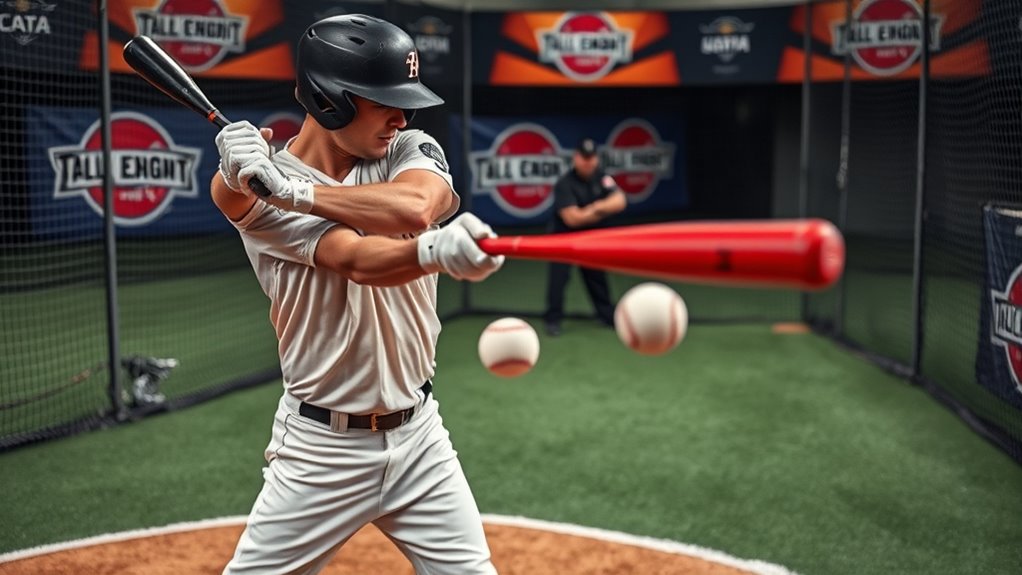

To improve bat control with foul-off drills, focus on maintaining a consistent stance and bat angle during each swing. Use tee or soft toss exercises to emphasize hitting the ball squarely and controlling contact points. Practice deliberately, slow at first, then gradually increase speed to build muscle memory. Pay close attention to your stance and contact point—small adjustments lead to greater control. Keep refining these fundamentals, and you’ll see your accuracy and finesse improve—more tips are ahead to sharpen your skills further.
Key Takeaways
- Use foul-off drills to improve bat control and develop better pitch recognition skills.
- Focus on maintaining a consistent stance and bat angle during drills to reinforce muscle memory.
- Practice slow, controlled swings to enhance contact point accuracy and overall bat control.
- Record and analyze swings to identify and correct stance or bat angle inconsistencies.
- Gradually increase swing speed while maintaining proper form to build confidence and control at higher velocities.
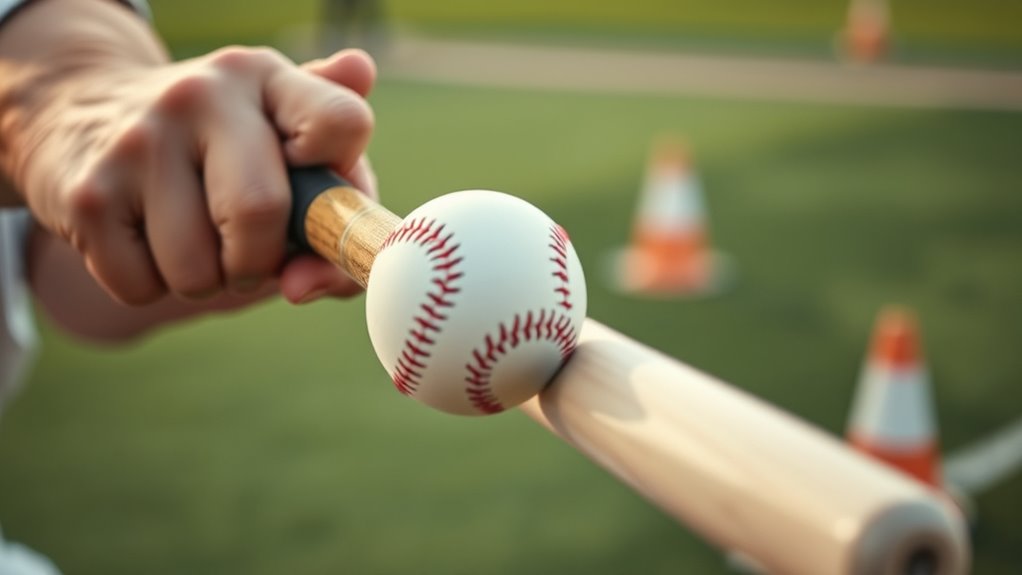
Effective bat control drills are essential for improving your swing and contact accuracy, especially when focusing on the contact point. One key aspect to master is your stance adjustment, which sets the foundation for a consistent and effective swing. When you start with a proper stance, you position yourself ideally to make contact with the ball. Adjust your feet so they’re shoulder-width apart, with your weight balanced on the balls of your feet. Keep your knees slightly bent and your back straight, allowing for quick, controlled movements. Minor stance adjustments can help you stay balanced and prepared for different pitch types, making your swings more precise.
Another critical element is the bat angle. Your bat angle influences how the ball contacts the bat and ultimately affects your control and power. To improve your contact point, focus on maintaining the correct bat angle throughout your swing. Typically, the bat should be slightly tilted upward, around a 45-degree angle, when you’re in the ready position. As you swing, keep this angle consistent, ensuring that the barrel of the bat meets the ball squarely. Practicing with a specific bat angle helps develop muscle memory, so you instinctively adjust your swing to make clean contact. It also reduces the chances of hitting the ball off the end of the bat or missing it entirely.
Incorporating stance adjustment and bat angle into your drills allows you to develop a more natural and efficient swing. Start by practicing slow, deliberate swings where you focus solely on your stance and bat angle. As you become more comfortable, increase your swing speed while maintaining proper form. Use tee drills or soft toss to focus on making contact at the same point consistently. During these drills, pay close attention to your stance—are your feet still shoulder-width apart? Is your weight evenly distributed? Is your bat held at the correct angle? Making small, conscious adjustments during practice helps reinforce good habits.
Additionally, understanding the importance of contact point can help you make more precise swings and improve overall hitting consistency. It’s also helpful to record yourself or work with a coach to analyze your stance and bat angle. Small tweaks can make a big difference in contact consistency. Over time, these adjustments will become second nature, leading to more reliable contact and better overall hitting performance. Remember, improving your bat control isn’t about drastic changes but fine-tuning your stance and bat angle for ideal contact. By focusing on these fundamentals during your drills, you’ll develop a more confident, controlled swing that consistently makes solid contact with the ball.

Tanner Tee The Original Batting Tee – Adjustable Pro Hitting Tee for Baseball & Softball, Steel Shaft, Composite Base, Hand-Rolled Rubber Top, 26"-43" Height
The Original pro-style Tanner batting tee that started it all. Trusted by more travel ball, youth, college and…
As an affiliate, we earn on qualifying purchases.
As an affiliate, we earn on qualifying purchases.
Frequently Asked Questions
How Can I Track My Progress in Improving Bat Control?
You can track your progress in improving bat control by recording your performance during practice sessions and games. Focus on maintaining mental focus and note how consistently you hit the contact point. Keep a journal or use video recordings to analyze your swings over time. This helps you see improvements, identify areas needing work, and stay motivated as your consistency improves. Regular tracking guarantees you’re making tangible progress.
What Equipment Is Essential for Effective Foul-Off Drills?
You’ll need a good bat grip and a proper drill setup for effective foul-off drills. Use a bat with a comfortable grip to maintain control during swings. Set up a pitching machine or a partner to toss consistent pitches, focusing on contact points. Mark specific areas on your hitting zone to aim for, helping refine your contact point and improve your foul-off control. This equipment guarantees focused, productive practice sessions.
How Do Weather Conditions Affect Contact Point Training?
Sure, weather impact and climate considerations might seem trivial, but they actually play a big role in your contact point training. Rain, wind, or extreme heat can throw off your timing and accuracy, making drills less effective. Wind can alter pitch trajectories, while humidity affects ball grip. So, you’ll want to schedule your sessions during ideal conditions to guarantee consistent results and avoid training setbacks caused by unpredictable weather.
Can These Drills Be Adapted for Young or Beginner Players?
Yes, you can adapt foul-off drills and contact point training for youth and beginner players. Focus on youth adaptability by simplifying techniques and using softer balls for safety. Make drills beginner friendly by breaking them into smaller steps, emphasizing proper contact points, and providing plenty of positive feedback. Keep sessions fun and engaging to build confidence, ensuring young players develop good habits early while enjoying their progress.
How Often Should I Practice These Drills for Optimal Results?
Think of practice as sharpening a blade; the sharper, the more precise. You should practice these drills at least 3-4 times a week to boost your bat speed and hand-eye coordination. Consistent effort helps build muscle memory, making your contact point more accurate. By dedicating regular time, you’ll see steady improvement in your control and confidence at the plate, turning those foul-offs into powerful hits.

SKLZ Catapult Soft Toss Baseball Pitching Machine for Batting and Fielding
Works on both the offensive and defensive aspects of the game
As an affiliate, we earn on qualifying purchases.
As an affiliate, we earn on qualifying purchases.
Conclusion
So, after all these foul-off drills and perfecting your contact point, you’d think hitting the ball would be a breeze. Yet, here’s the irony: the more you focus on control, the trickier it gets to avoid swinging wildly. But don’t worry—keep practicing those drills. Eventually, you’ll master the art of control so well, you’ll surprise everyone, including yourself, by knocking that foul into the stands… or at least making solid contact.

SKLZ Hit-A-Way Batting Swing Trainer for Baseball and Softball, Baseball , Black
Improve timing and confidence
As an affiliate, we earn on qualifying purchases.
As an affiliate, we earn on qualifying purchases.

GoSports 2.8 inch Weighted Training Baseballs – Hitting & Pitching Training for All Skill Levels – Improve Power and Mechanics
WEIGHTED TRAINING BALLS: Set includes a 6 pack of 16oz training balls measuring 2.8 inches for baseball and…
As an affiliate, we earn on qualifying purchases.
As an affiliate, we earn on qualifying purchases.