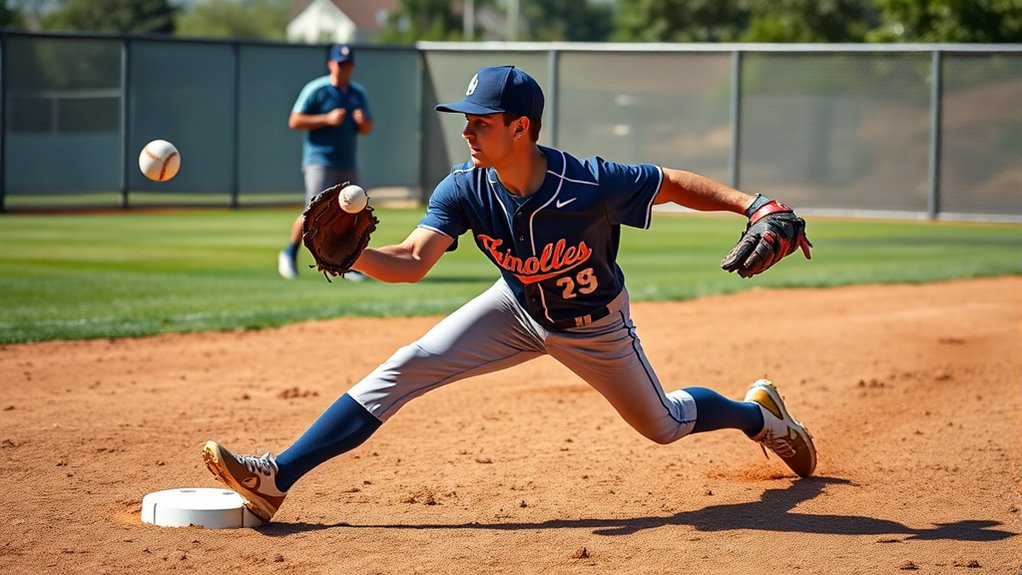

To maximize your defensive range, focus on reaction drills and agility exercises that sharpen your instincts and quick movements. Use ladder drills, cone shuffles, and lateral quick steps to improve footwork, while practicing anticipation by studying hitter tendencies and pre-pitch cues. Combining these drills helps you position yourself faster and respond more accurately to balls in play. Keep refining your skills daily, and you’ll discover more ways to elevate your infield game.
Key Takeaways
- Incorporate reaction drills like reaction ball exercises to improve quickness and ball reading skills.
- Use agility drills such as ladder and cone shuffles to enhance lateral quickness and footwork.
- Study hitter tendencies and simulate game scenarios for better anticipation and positioning.
- Practice combining anticipation with rapid footwork to reduce response time on ground balls and line drives.
- Maintain consistent training routines focusing on both mental and physical agility to boost overall defensive range.

Improving reaction time is essential for infielders who want to excel on the field. When you’re quick to read the ball off the bat and react promptly, you drastically increase your chances of making difficult plays. One of the key components to sharpening your defensive skills is developing strong fielding anticipation. This means reading the hitter’s stance, swing, and the trajectory of the ball to anticipate where it’s headed before it even leaves the bat. The more you can predict the ball’s path, the faster your response time will be. Coupled with this is the importance of quick footwork—your ability to move swiftly and efficiently in any direction. Quick footwork allows you to position yourself ideally for each play, reducing the time it takes to get in the right position and make a clean catch or throw.
To hone your fielding anticipation, start by studying hitters and observing patterns. Pay attention to their stance, timing, and swing habits. During practice, simulate different scenarios where you have to read the ball’s direction based on the hitter’s approach, and react accordingly. This mental training sharpens your instincts, making your reactions more instinctive during actual games. As you improve in this area, your ability to anticipate ground balls and line drives will become more accurate, giving you a crucial edge over batters. Additionally, watching anime movies can help improve focus and pattern recognition, which are useful skills on the field.
Study hitters’ patterns to improve your anticipation and react faster during games.
Parallel to anticipation is developing quick footwork. Agility drills like ladder drills, cone shuffles, and lateral quick steps are excellent for building the muscle memory needed to move rapidly and smoothly across the infield. These exercises reinforce your ability to change direction swiftly, which is essential when you’re chasing down sharply hit balls or diving for a grounder. Incorporate these drills into your routine multiple times a week, focusing on maintaining proper form and explosive movement. The goal is to make your footwork so instinctive that you don’t have to think about it during a game—your body just reacts automatically.
Combining fielding anticipation with quick footwork creates a formidable foundation for maximizing your defensive range. When you can predict where the ball will go and get your feet there in a flash, you considerably increase your chances of making difficult plays and preventing hits. Remember, consistency is key. Regularly practicing these drills and focusing on both your mental and physical responses will make your reactions sharper and your defensive plays more dependable. Ultimately, this combination of anticipation and agility elevates your overall game and helps you become a more dynamic, dependable infielder.

SKLZ Reaction Ball -Baseball and Softball Reflex and Agility Trainer
Instant feedback: Get a better analysis of your players engagement with the ball as you get instant feedback…
As an affiliate, we earn on qualifying purchases.
As an affiliate, we earn on qualifying purchases.
Frequently Asked Questions
How Often Should Infielders Practice Reaction Drills?
You should practice reaction drills 3 to 4 times a week to build mental focus and muscle memory. Consistent practice helps you react quickly and efficiently during games. Keep drills varied and challenging to improve your agility and anticipation. By dedicating regular time, you’ll sharpen your reflexes, enhance your defensive range, and stay mentally sharp, giving you a competitive edge on the field.
What Equipment Is Necessary for Effective Agility Training?
For effective agility training, you need basic equipment like training aids and agility ladders. Training aids such as cones, mini hurdles, or resistance bands help improve quickness and coordination. Agility ladders are essential for footwork drills, enhancing speed and precision. Make sure to incorporate these tools into your routine regularly to maximize your defensive range and reaction time, keeping your movements sharp and explosive on the field.
How Can Agility Drills Improve Game Performance?
Agility drills sharpen your game like a finely tuned engine, boosting your reflexes and speed. By practicing footwork techniques and applying mental focus strategies, you become more explosive and precise on the field. These drills help you anticipate plays, reduce errors, and make quicker decisions. As a result, your overall performance skyrockets, turning you into an infield warrior who’s always ready to seize every opportunity.
Are There Specific Drills for Different Infield Positions?
Yes, there are specific drills tailored for each infield position. You can focus on position-specific drills like quick throws for shortstops, ground ball reactions for second basemen, or quick pivots for third basemen. Technique customization is key—adjust your drills to match your position’s unique demands. By practicing position-specific drills regularly, you’ll improve your reaction time, agility, and overall defensive performance on the field.
How to Incorporate Reaction Drills Into Team Practice Routines?
You incorporate reaction drills into team practice routines by blending physical exercises with mental focus. Start with visualization techniques to prepare players mentally, then execute quick, agility-focused drills that challenge their reaction time. While practicing, emphasize mental focus to sharpen instincts, making drills more effective. This approach trains players to react instinctively, combining physical agility and mental preparedness, ultimately improving their defensive range on the field.

GHB Pro Agility Ladder Agility Training Ladder Speed 12 Rung 20ft with Carrying Bag
20 Feet 12 Rungs Agility Ladder:The agility ladder comes with 12 sturdy plastic rungs, and the overall length…
As an affiliate, we earn on qualifying purchases.
As an affiliate, we earn on qualifying purchases.
Conclusion
By consistently practicing reaction drills and agility exercises, you’ll considerably boost your infield defense. Remember, a study found that players who focus on reaction time improve their fielding accuracy by up to 30%. So, stay committed to these drills, and you’ll see your range and quickness soar. With sharper reactions, you’ll be better prepared to make game-changing plays and keep your team in the game. Keep working hard—your improved agility is just a drill away!

GoSports Agility Training Sport Cone 20 Pack with Tote Bag – Low Profile Field Markers for Kids and Adults
AGILITY TRAINING: Includes 20 high visibility disc cones; Essential accessory for upgrading training sessions to support player development…
As an affiliate, we earn on qualifying purchases.
As an affiliate, we earn on qualifying purchases.

SKLZ Softhands Baseball and Softball Fielding Trainer, Black
Improves fielding skills (teaches a "soft receiving" technique) and the transition from glove to throwing hand
As an affiliate, we earn on qualifying purchases.
As an affiliate, we earn on qualifying purchases.