
Get sports gear delivered free with Prime
- Fast, free delivery on millions of items
- Prime Video, Amazon Music and more included
- Member-only deals all year
A race call becomes the main event
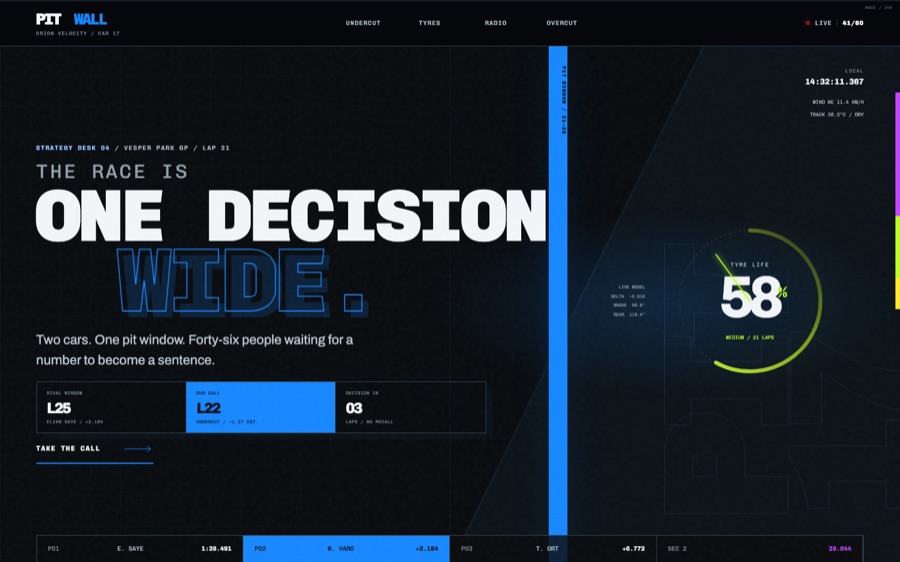
PITWALL is an AI-built exhibition piece: a fictional racing strategy desk designed to make one tactical choice feel like it could change the whole afternoon. Its fictional Orion Velocity team is part of the concept, not a real company. Instead of leaning on car photography or familiar motorsport spectacle, the room puts the decision itself in the spotlight: timing data crowds the edges while a vivid blue console invites you to choose when to pit.
The signature move is decision theater. A slider changes the race scenario, the chart responds, and the interface turns a prediction into a call that must be committed. The result is less a static mock dashboard than a small performance about uncertainty: weigh the numbers, hesitate, then send the instruction.
As an affiliate, we earn on qualifying purchases.
Inside the timing-screen aesthetic
The visual system borrows the grammar of a race control display. Near-black provides the ground, while pit-window blue owns the central interaction. Green, yellow, purple, and radio red act as signals rather than decoration. Chivo Mono gives figures and verdicts an official, instrument-like quality; Archivo makes the explanatory passages easier to read amid the dense information. Large, tightly tracked headings contrast with more relaxed body text.
Those details support the main interaction: an undercut simulator. Move the controls and the model compares two fictional cars across a run, accounting for tyre age, warm-up, pit-lane loss, traffic, and a safety-car adjustment. The changing gap is plotted as an SVG trace, with the pit marker and crossover arithmetic updated alongside it. The interface presents the calculation as part of the experience, so the chart is not merely a visual flourish: it helps explain why the recommendation changes.
The call itself has a deliberate threshold. A pointer or keyboard hold fills a transmit rail; completing the hold triggers a blue scan, marks the selected lap and outcome on the chart, and carries the result into an after-flag panel. Change an input, and the receipt is invalidated. That small rule gives the choice a before and after—and makes the simulated commitment legible.
The rest of the room extends the same engineered language without relying on image libraries: tyre diagrams, degradation curves, radio waveforms, data panels, and texture are drawn with HTML, CSS, SVG, and JavaScript. The editorial chapters shift the pace, including a passage that frames the overcut as an unexpected alternative. Reduced-motion support removes several effects, and the hero clock pauses when the page is hidden.

Want this? Paste this into your AI coding agent
Build a single-page showcase website from this art-direction brief. Work like an elite creative frontend engineer; commit totally to the direction.
BRIEF (room 146 of 175, “pitwall”):
PITWALL — the strategy desk: race engineering as a decision theater (fictional team, generic series). Aesthetic: timing-screen black; probability under pressure. Palette: timing black, sector purple/green/yellow, pit-window blue, radio red. Fonts: chivo-mono (timing screens), archivo (body). SIGNATURE: THE UNDERCUT — a live two-car strategy simulator: choose YOUR pit lap on a slider and watch gap traces diverge on an animating SVG chart (tire-delta arithmetic annotated as it happens: out-lap fury vs held track position); the sim celebrates or indicts your call. Tire-degradation curves rendered as gorgeous decaying gradients, a safety-car probability dial that reshuffles everything, “box box” radio-transcript cards with the pause before the answer, the overcut heresy chapter. Delta-time typography study (why +0.8 hurts more in mono). Unforgettable: winning or losing a race with one slider.STACK: pure HTML/CSS/JS, no build step, no frameworks, no CDNs or external requests of any kind; self-hosted fonts only; every visual is code (CSS/SVG/canvas/WebGL) — no image assets required.
QUALITY BAR: flawless at 390px, 834px and 1440px with zero horizontal overflow; tap targets >= 44px; semantic landmarks, focus-visible styles, body-text contrast >= 4.5:1; prefers-reduced-motion pauses or simplifies heavy animation; rAF loops pause when the tab is hidden; hold 60fps (cap particle counts, avoid layout thrash); rich invented content everywhere — real-sounding names, numbers and program notes, never lorem ipsum; orchestrate one beautiful staggered load moment plus scroll and hover surprises. FORBIDDEN: Inter/Roboto/Arial/system-ui, purple-gradient-on-white, and cookie-cutter hero+cards+footer layouts.
PROCESS: iterate in three documented passes — (1) build plus builder self-critique, (2) merciless external critique finding and fixing at least ten real problems, (3) art-director elevation from good to unforgettable. Screenshot at all three widths every pass and fix everything you can see.
— Original brief by Claude Fable 5 (art director), executed by the FABLE/175 pipeline.
— This room lives at https://fable-25-830.netlify.app/sites/pitwall/
This is the verbatim art-direction brief that produced the room — exposed by the exhibition itself via the “Prompt” link in the room’s footer.
motorsport decision simulation software
As an affiliate, we earn on qualifying purchases.
As an affiliate, we earn on qualifying purchases.
From prototype to certified room
The work follows a three-pass pipeline: build the interactive room, critique it mercilessly across phone, tablet, and desktop layouts, then have an art director certify the result after flaws are fixed. The accompanying field guide documents the concept, visual techniques, design tokens, and reproduction approach, including the simulator and its accessible controls. The AI built the site; that is the story behind this exhibition piece, not a claim that a real racing team commissioned it.
The full build notes live in the room’s design guide.
race strategy visualization tools
As an affiliate, we earn on qualifying purchases.
As an affiliate, we earn on qualifying purchases.
Make the call
Visit the live PITWALL room to try the strategy console and explore its race-day atmosphere. Then browse all 175 rooms at the exhibition hub for more AI-built experiments in web design.
Visit the live room → · Browse all 175 rooms
Previously in Wing VI
- Room 138: APEXWERK — The Grip Curriculum
- Room 127: Meridian 843 | The Measured Mile
- Room 136: Courier — Spoke & Signal
FABLE / 175 is a finished exhibition of 175 fundamentally different websites, each built end-to-end by an AI. This article is part of our series walking through it room by room.
AI-powered racing strategy dashboard
As an affiliate, we earn on qualifying purchases.
As an affiliate, we earn on qualifying purchases.
NFL season / tailgating Picks
team gear
As an affiliate, we earn on qualifying purchases.